


👋 Welcome to Ruckus Makers the home of Selfmentorship. We write for leaders who are done waiting for the system to develop them and have taken radical control of their growth. If that’s you, then subscribe below and you’ll know the moment a new mini-book drops ⚡️
The Halloween Party
It’s Halloween 2001.
I’m at a party hosted by my colleague Ms. Sneed — a fellow language arts teacher and, I would come to learn, a legendary southern host.
I’m a Yankee. Fresh out of Illinois. I took a job in Georgia partly because I was sick of the cold, partly because of two spring breaks at Panama City and New Orleans that convinced me the South was where I needed to be. I’m an outsider who’s been welcomed in, and I’m grateful for it.
The party is everything. Music. Jello shots. Shrek and Harry Potter and Freddie Krueger. A Statue of Liberty — patriotism still running high two months after September 11th.
And then there’s me.
Hoodie. T-shirt. Jeans.
Not a costume. My weekend outfit.
Here’s why: My best friend Casey won the coin toss for our shared Super Chicken costume — a yellow chicken suit with red underpants and a red cape that absolutely killed at parties. He went to a different Halloween party. I went to Ms. Sneed’s. No costume.
So I did what any slightly creative 22-year-old would do.
I printed 1,000 business cards. One side: Kokopelli — Halloween 2001. The other side: You’ve been pranked.
For the rest of the night, I moved through every room of that house. Cards in the couch cushions. Cards in the CD cases. Cards in the medicine cabinet, between the cotton balls, inside the aspirin bottles. Cards between every plate in the kitchen, in every glass, possibly in the food inside the fridge.
Once the cards were gone, I had one last beer and went home.
Mid-December. Last day before Christmas break. I stopped by Ms. Sneed’s classroom to wish her a Merry Christmas — and she was dying with laughter when I walked in.
“Danny,” she said. “We’re still finding your cards.”
Two months later. Fifty-fifty: frustrating and hilarious.
Nobody remembered what anybody else wore that Halloween. I can guarantee that. But Ms. Sneed — who I’m told is still hosting those legendary Halloween bashes — probably still tells the story of Kokopelli and the cards.

When you lean into your different, you have a much bigger impact.
That’s what I wanted to talk about.
Why School Marketing Is Ineffective and Forgettable.
I spent time doing recruitment and admissions at a top-10 school in Chicago. Highly selective. Great outcomes. The kind of place you’d be proud to say you worked.
And when I went to recruitment fairs, I was excited. We had a strong story to tell.
But when I looked around the room — at our table, at everybody else’s table — we looked identical. Same setup. Same talking points. Same energy. Same pitch.
Here’s our school ranking. Here’s what we offer. Please consider us.
We were trying to fit in when we should have been trying to stand out.
Later, as a middle school principal in Houston, I watched the same thing play out in hiring. The candidates who got the highest marks from our panel all dressed the same, went to the same university, had the same kinds of experiences. No appetite for risk. No room for someone who came to the table differently.
I found it incredibly frustrating.
Here’s the thing most school leaders won’t say out loud:
The average job posting could belong to any school in the country. Swap the name at the top, and nobody would notice.
Rigorous curriculum. Collaborative culture. Student-centered learning. Passionate, dedicated team.
Every single school says this.
And the problem isn’t that it’s untrue. The problem is that it’s not yours.
When your marketing sounds like everyone else’s, you attract everyone — and no one in particular. You get applicants who are shopping. Families who are comparing. You get the people who will go wherever the commute is shortest or the salary is highest, because you’ve given them nothing else to decide on.
The best teachers, the best families, the best students — they’re not looking for a school that checks boxes. They’re looking for a school that stands for something. A school that’s clearly, unapologetically, for people like them.
And they will drive past three other schools to find it.
The question is whether they’ll find yours.
Category Design Is Not Branding
A lot of school leaders hear “stand out more” and think: new logo. Better website. More social media posts.
That’s branding. And it’s not what I’m talking about.
Category design is a different idea entirely.
It comes from the business world — from thinkers like Christopher Lochhead and Eddie Yoon — but the principle translates directly to schools. Category design says: don’t compete for the same position everyone else is fighting for. Create a new position. Name what’s broken. Build the thing that solves it. Then make sure everyone knows you’re the only one doing it.
In school terms: stop trying to be the best school. Be the only school that does what you do, the way you do it.
I have a friend named Loren. He’s a principal of an arts integration elementary school in Washington, DC. He called me once from a recruitment fair — bored, discouraged, not getting any traction. As we talked, it became clear what was happening: he was showing up exactly like everyone else. Table. Banner. Brochure. Talking points.
I asked him: What makes your school different?
He knew immediately. Arts integration. Every subject taught through and alongside the arts. Not as an elective. As the curriculum. Not something other schools aspire to do — the absolute focal point of everything.
I told him: that’s your whole presentation. That’s the headline. That’s the thing that makes a certain kind of teacher stop walking, turn around, and come back to your table.
By his next recruitment fair, he had a line.
He also plays violin. Loves a bow tie. Has learned to be open about his family, his hobbies, the things that make him him. Three or four years in, his staff started wearing bow ties too — not mockingly. As a kind of tribute. A signal that they’d found their people.
That’s category design. When your school has a clear enough identity that the right people self-select in — and the wrong people self-select out.
The Four Moves
Category design isn’t magic. It’s a set of choices. Most schools never make them — not because they can’t, but because nobody ever asked them to.
Here are the four moves that change everything.
Move 1: Get Clear on Your Legendary Outcome
Not your test scores. Not your college acceptance rate. Not your graduation numbers.
Your legendary outcome is the transformation your school produces that couldn’t happen anywhere else.
What happens to a kid — or a teacher — after three years with you that couldn’t happen at the school down the street? What do your families say when they describe why they stayed? What do your teachers tell their friends when they explain why they drive past three other schools to come to work?
This is the question most schools can’t answer. And it’s the most important one.
One of the leaders in a session I ran recently — Ted, an executive director of a charter school — had the answer sitting in his data and didn’t know it. He’d added a question to his staff’s intent-to-return form: Why are you staying — and what would you tell a future employee?
He had a library of authentic, specific, emotionally honest responses. Teachers describing the moment they realized this school was different. Stories about trust, autonomy, belonging, purpose.
He wasn’t using any of it prominently.
That’s your legendary outcome, hiding in plain sight. Find it. Name it. Lead with it.
Move 2: Lean Into Your Different
Your school has something no other school has. It might be a program, a philosophy, a practice, a design — or it might just be you.
Loren plays violin. Loves bow ties. Built a school around arts integration so deep and intentional that the arts aren’t an add-on — they’re the architecture. He stopped hiding any of that and started leading with all of it.
Here’s the test: If you removed your school’s name from your marketing and replaced it with a competitor’s, would anything break?
If the answer is no — if the copy still works — you’ve failed the test.
Great positioning is non-transferable. Your different is the raw material. Amplify it. Repeat it. Build your whole recruitment message around it.
The fear, usually, is: What if being different repels some people?
That’s the point.

A $4 sheep’s milk yogurt popsicle repels the person who wanted a 78-cent ice pop from the freezer aisle. And it attracts exactly the right person — the one who gets it, who wanted this, who tells their friends.
You don’t need every teacher. You need the right ones.
Move 3: Make Your Core Values Sticky
Integrity. Excellence. Respect.
Nobody believes this anymore. Not because the words are wrong — because they could be posted in any school in the country. Values that belong to everyone belong to no one.
Sticky values are specific. They’re lived, not laminated. They have stories behind them — specific moments, real examples, things that happened at your school that nobody could have scripted. They’re a little polarizing. The right person reads them and feels recognized. The wrong person reads them and quietly decides this isn’t the place for them.
Both outcomes are wins.
Ask yourself: Can your staff name your values without looking at the wall? Can they tell you what those values look like in action on your specific campus? Can they give you an example from last week?
If the answer is no, you don’t have core values. You have a poster.

Move 4: Reject the Premise
Most school marketing starts from the same premise: We want to be everything to everyone who might possibly choose us.
The application pool is shrinking. The teacher shortage is real. The pressure to fill seats and positions is intense. So the instinct is to cast the widest net possible — soften the edges, remove anything that might push someone away, keep the message broad enough that nobody feels excluded.
This is exactly backwards.
The school that says we’re not for everyone, and that’s the point fills its seats with the right people. The school that says here’s the specific problem we’re solving, and here’s why traditional schools haven’t solved it attracts the teacher who’s been waiting for exactly that.
Fall in love with the problem.
Don’t fall in love with your solution. Don’t lead with how great your school is. Lead with what’s broken about the status quo — name the frustration that the right candidate already carries — and then show them that you’ve built the answer.
You know what’s wrong with most schools. So do we. Here’s what we built instead.
That’s not a threat. It’s a signal. It tells the right person they’ve found their people.

The Brevard Academy Teardown
Ted is the executive director of Brevard Academy, a charter school. During a live session, he pulled up his school’s employment page and asked for feedback.
Here’s what I saw:
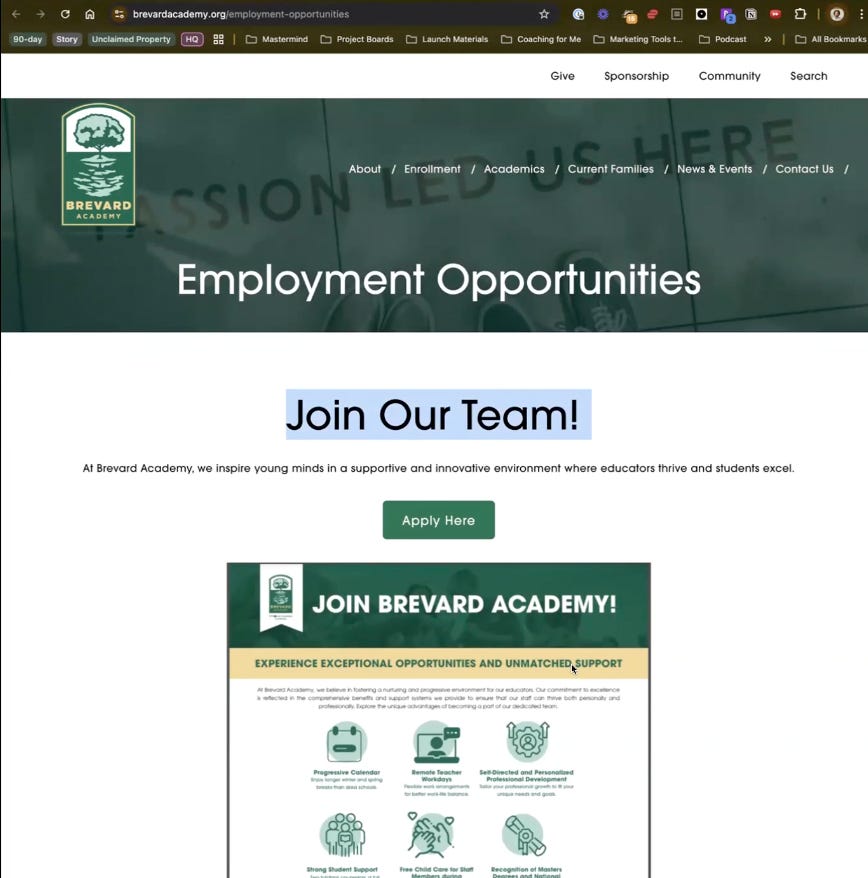
A headline that said Join Our Team. A logo. A paragraph about the school. Nine things listed below the fold. A button to apply.
It’s not bad. A lot of schools would be happy with this page.
But here’s the coaching:
The headline is talking to itself.
Join Our Team — they’re already on the employment page. They know why they’re there. You’ve used your most valuable real estate to say something they already know. That space belongs to your legendary outcome, your point of view, your most compelling reason why.
The good stuff is buried.
Ted had a list of nine things that made his school different from traditional schools. It was specific, honest, and compelling. It was below the fold — after the logo, after the boilerplate, after the reader had already scrolled past their attention span. Lead with it. Make it big. Make it bold.
The social proof is invisible.
Ted’s intent-to-return form had given him a library of authentic teacher quotes. Real people. Real reasons. Real transformation. None of it was on the page. It should be front and center — not as a testimonials sidebar, but as the emotional core of why someone would choose this school.
The framing is school-centric.
Almost everything on the page was about Brevard Academy. What a reader wants to know is: What happens to me if I come here? What will I be able to do that I can’t do anywhere else? How will my life be different?
Flip the frame. Don’t talk about your school. Talk to the teacher you want to hire.
(read that line again — 99% of leaders in K12 do not understand this!)
Ted had one more insight during that session — one that I think is the whole idea in miniature. He said: “I’m going to go talk to the teachers we hired from traditional schools last year. The ones who said, ‘I can’t believe a place like this exists.’ And I’m going to ask them to tell me more about that.”
That’s the marketing.
The teachers who said I can’t believe a place like this exists.
They have the story you need to tell.
They crossed over from the status quo.
They can describe what they left and what they found.
They can speak directly to the candidate who is still stuck in a school that isn’t this.
Let them.
Your Turn
Answer this:
Why would a great teacher drive past three other schools to work at yours?
Not a good teacher. A great one. The one who has options. The one who knows what they want and won’t settle for less.
If your answer sounds generic — if it could describe any school in your zip code — you’re not done yet.
The schools that win the talent war aren’t the best-resourced. They’re the most unapologetically themselves. They’ve done the work to name what they stand for, who they’re for, and why the status quo isn’t good enough.
That work doesn’t require a new logo or a bigger budget.
It requires a clear point of view.
You already have one. Most leaders do. They’ve just been trained to hide it — to sand down the edges, to fit in, to not make waves.
This is your permission to stop.
Make a ruckus. Lead with your different. Build the school that the right teacher has been looking for — and then make sure they can find it.
If this landed for you, here are a few ways to keep going.
Meet Digital Danny. Digital Danny is your Selfmentorship guide. Always available. Never flatters. Evolves with you. Start your 7-day trial here.
Join the Ruckus Maker Mastermind. If you’re serious about Selfmentorship and want a community of Ruckus Makers doing the work alongside you, this is where they are. Learn more and apply here.
Listen to the Better Leaders Better Schools Ruckuscast. Over 10 years of conversations with the most interesting people doing the most interesting work in school leadership. Every episode is a Mirror Person who knows more than you about something you care about. Start here.