

👋 Welcome to Ruckus Makers the home of Selfmentorship. We write for leaders who are done waiting for the system to develop them and have taken radical control of their growth. If that’s you, then subscribe below and you’ll know the moment a new mini-book drops ⚡️
The Day I Met Scott Long
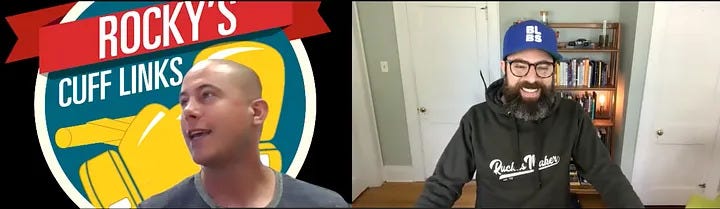
Scott Long was a second-year principal at Doherty Elementary in Michigan when he called me.
He wasn’t in crisis. His school wasn’t failing. His staff wasn’t revolting. By every traditional measure, things were fine.
Fine was the problem.
Scott had been listening to the podcast. He’d joined the Mastermind. He was the kind of leader who heard an idea and actually did something with it … which, if you’ve spent any time around school leaders, you know is rarer than it sounds.
He’d heard me teach something called Sticky Core Values, and it had lit him up. Not because his school was broken. Because he could see clearly what was missing.
“I talked to my wife about it,” he told me. “Her company has core values. I asked her to name them.”
She couldn’t.
Not one.
And she wasn’t checked out. She wasn’t disengaged. She was a high-performing professional at a company that cared enough to write the values down, design them into slides, and present them at all-hands meetings.
She still couldn’t name them.
Scott saw his school in that moment. And if he’s being honest, most of his staff probably couldn’t name those either.
That conversation started something that would eventually ripple through his entire building, show up in science classrooms, travel with his staff long after he’d moved on and get retold by a seven-year-old girl holding a marigold.
But we’ll get there.
First, let’s talk about the poster.
Prefer listening? Check out the audio version 👇

The Poster Nobody Reads
Walk into almost any school in America and you’ll find it.
Hanging in the main hallway, usually laminated, sometimes framed. Big enough to read from a distance. Probably designed in Canva by someone with good intentions and a free afternoon.
Integrity. Excellence. Respect. Courage. Innovation.
Or some version of those five words.
Nobody reads it.
Not really.
Not in the way that changes anything. Not in the way that helps a teacher decide how to handle a hard moment in a classroom, or helps a student understand why the adult in front of them is asking them to do something hard, or helps a new staff member understand who this school actually is.
The words just hang there.
And it’s not your fault.
That poster probably existed before you arrived. Those values were chosen by a committee, at a meeting, probably a decade ago, by people who meant well and then moved on. The system handed them to you the same way it handed you the keys and said don’t mess this up.
But here’s what I want you to sit with: those values could hang in any school in America.
Any. Single. School.
And because of that, they’re forgettable.
Courage? Sure. Integrity? Obviously. Respect? Every school in the country has that one. These are what Patrick Lencioni calls “permission to play” values — the minimum standard, the table stakes, the things we just assume about any halfway decent organization.
They’re not wrong. They’re just invisible.
Seth Godin has a concept called the Purple Cow. The idea is simple: when you’re driving through the countryside and you see cows, you don’t notice them. Brown and black spotted cows are everywhere. You’ve seen a thousand of them. Your brain filters them out.
But if you saw a purple cow?
You’d stop the car.
Traditional core values are brown cows. Nobody stops. Nobody looks. Nobody remembers.
Your school deserves a purple cow.
What Sticky Core Values Actually Are
Before I tell you what sticky core values are, let me tell you what they are not.
They are not a rebrand. You don’t fix a forgettable culture by hiring a designer and choosing better fonts.
They are not aspirational. This is the trap most leaders fall into. They write the values they wish their school lived by instead of the ones it already does. Aspirational values are what every school claims. They read like a mission statement that could belong to anyone.
And they are definitely not one word. One word gives you nothing to hold onto. One word is a bumper sticker. One word does not tell me how to handle the parent in my doorway at 7:30am.
Sticky core values are memorable phrases that tell the story of how your school operates at its best.
Five qualities make them work:
Simple. Easy to say, easy to remember. If you can’t say it to a stressed-out teacher in the middle of a hard week and have it land, it’s not simple enough.
Meaningful. There’s a story behind it. A real one. Something your community lived, something that happened here, something specific enough that it belongs to you.
Behavior-driven. It tells people how to act. Not what to believe in the abstract — what to do when things get hard.
Memorable. It doesn’t sound like every other school. It could not be copy-pasted into a different building and make the same sense.
Reinforced constantly. It shows up in meetings, in recognition, in hard conversations, in the way you celebrate people. It’s not on a poster. It’s in the room.
That last one is worth slowing down on.
A sticky core value that only lives on the wall is just a better-looking poster. The stickiness doesn’t come from the phrase. It comes from the stories you tell about it, the rituals you build around it, and the consistency with which you bring it back.
But the stickiness starts somewhere specific.
It starts with a story.
The Story Is the Glue
Scott Long is a huge Rocky fan.
Almost to a fault, he’ll tell you.
When he started thinking about what a sticky core value might look like for Doherty Elementary, he kept coming back to one scene from the original Rocky. Mickey — Rocky’s gruff, demanding, deeply loving trainer — gives Rocky a pair of cufflinks that belonged to Rocky Marciano. He puts his arm around him. He pushes him harder than anyone ever has. He tells him he believes in him.
That relationship, between a mentor and someone willing to be pushed, was already alive at Doherty.
Scott had watched it.
In his first year as principal, before he had a name for what he was seeing, he noticed how the staff had each other’s backs. How they supported each other through hard things. How they showed up for each other the way Mickey showed up for Rocky.
So he gave it a name.
Rocky’s Cufflinks.
And then he did something most leaders wouldn’t do.
He brought it to his staff as an example (not as a decree). He put Rocky posters around the building. He asked people to guess what it meant. He created space for curiosity before he ever explained the idea.
And then he said: now you try.
What followed changed his school.
A teacher named Sophia — a musician who moonlighted as a performer doing Motown and classic rock — came up with R-E-S-P-E-C-T, connecting it to Aretha Franklin and to a night the staff had watched her perform and seen something extraordinary come out from under her voice. Everyone in that room had been there. Everyone remembered. The value already existed. She just gave it a name.
A teacher named Leah designed Find Your Marigold — the idea that marigolds grow and thrive no matter what surrounds them, and that the staff at Doherty could be that for each other and for their students. Resilient. Positive. A force.
Another teacher created All Hands In — a ritual and a value at once, with a call-and-response that ended every gathering: Who are we? Who are we? We are … we are … Doherty, go Dolphins.
Scott didn’t create those last three. He’s proud to tell you that.
And that’s the point.
The story is the glue.
Not the phrase itself. The story behind the phrase.
Rocky’s Cufflinks means something because people know the scene, know what Mickey meant to Rocky, and can see it in how their colleagues show up for each other. R-E-S-P-E-C-T means something because they were in that club that night watching Sophia perform and felt something they didn’t have words for yet. Find Your Marigold means something because Leah put her whole self into designing it.
Values that are handed down don’t work because they have no story.
Values that are built together stick because the story belongs to everyone.
Patrick Lencioni says your core values should be ones you’re willing to get in trouble for because you’re living them out that fully.
That’s the test.
But you can only pass that test if you can tell the story of why the value matters in the first place.
A handful of sentences. Something any staff member could tell a new hire in the first week. Something a student could explain to their parents at dinner.
That’s the standard.
How to Build Them Without Doing It Alone
Here’s where most leaders get stuck.
The idea sounds right. The examples land. And then they go back to their building and stare at a blank page wondering where to start.
Here’s the process Scott used, and it’s the one I’ve seen work most consistently.
You go first.
Don’t walk into the room empty-handed. Bring one to the table. Model what you’re asking for. Scott came in with Rocky’s Cufflinks already developed — the story, the meaning, the connection to what he’d observed in his school. He didn’t present it as here are your values. He presented it as here’s what one of these looks like. Now you try.
That’s different.
It gives people a template, not just a task. They can see the shape of the thing before they’re asked to build it.
One important note: hold it loosely. If Rocky’s Cufflinks hadn’t resonated, Scott would have let it go. You’re not presenting a done deal. You’re modeling a process. There’s a difference.
Go collaborative.
Small groups work best. Three to four people. Give them a starting point like your existing norms, your social contract, whatever language your school already uses to describe itself. Ask them to look at where you’re already exceptional. Not where you want to be. Where you already are.
Then ask for the story behind it.
“Where does that show up in our culture? Tell me a moment. Tell me a name. Tell me what it looked like.”
You’ll find the stories are already there. Your job is to excavate them, not invent them.
Let the community vote.
Draft phrases go back to the full staff. They read them, think about them, and choose the ones that hit hardest. This step matters more than most leaders realize. Authorship builds ownership, but so does choice.
When your staff selects the values they’ll live by, they’re not just following a leader’s direction. They’re making a commitment.
Give them legs.
This is where sticky core values come alive or die.
You need rituals. You need artifacts. You need ways to bring the values into the room on a regular basis.
Scott built a plaque where names get added when someone lives out a value. He started weekly check-ins where staff submitted shout-outs (up to 50 a week) naming a colleague and the value they’d lived. He collected them all and delivered them to inboxes every Monday morning. He put fat head logos outside classroom doors when someone was recognized.
He opened meetings with the values and closed with All Hands In.
He made the values the center of how his school celebrated, corrected, and recognized people.
That’s what reinforced constantly actually means. Not a slide in a back-to-school presentation. Not a poster in the hallway. The values showing up everywhere, all the time, until they’re so embedded in how the building operates that they don’t need you to exist.
The Long Game
Year One is exciting.
The values are new. People are fired up. There’s momentum in the building. You see it in how staff talks to each other and how students talk about their school.
Year Three is where most schools go back to the poster.
The energy fades. New staff come in and don’t know the stories. The values start to feel like old news. And slowly, without anyone deciding to let them go, they drift back into the wallpaper.
This is the challenge nobody warns you about.
And so, a reframe.
Your sticky core values are a curriculum. Teach them like one.
That means you don’t teach them once in August and assume people got it. You come back to them. Every year. Every month. Every week if you can.
Brené Brown has a move I love for this: three examples of what this looks like, three non-examples. Get your staff in a room and ask, Give me three times you’ve seen Rocky’s Cufflinks lived out this year. Give me three times we fell short. That conversation does more for culture than any keynote speaker ever will … unless you’re bringing me in :)
It materializes the value. It makes it real, specific, and honest.
You also don’t need a new school theme every August.
I see it every year on social media.
Principals asking each other what their theme is going to be, hunting for something fresh and clever and memorable. That’s the wrong question. Your school theme is your sticky core values. They don’t expire. They don’t need to be retired and replaced. They need to be lived more deeply.
The goal is not novelty. The goal is depth.
Once you have the strategy, your job as a leader is mostly to repeat it until you’re bored. And then keep repeating it, because by the time you’re bored, your community is just starting to really hear it.
Use them in hiring. When you’re bringing someone new into the building, the values aren’t just a slide in the onboarding deck. They’re a conversation. Does this person understand what Rocky’s Cufflinks means here? Can they tell me what it would look like in their classroom?
Use them in hard conversations. When a staff member falls short of the expectation, of the culture, of what the team deserves. The values give you language. This isn’t personal. This is about what we agreed to. This is about Rocky’s Cufflinks, and what we said that means here.
Use them in celebration. Not just big recognition moments. The small ones. The Monday shout-out email. The name on the plaque. The moment you stop someone in the hallway and say that was Find Your Marigold and I saw it and I want you to know I saw it.
Those moments compound. Over time, they become the culture.
What Scott Said Before He Left
A few years after our first conversation, I checked back in with Scott.
He’d been thinking about what would happen if he walked away from Doherty. If he got a different opportunity, moved to a different building, moved up.
He told me he was confident the culture would carry on.
Not because he was indispensable. Because he wasn’t.
The values didn’t live in him anymore. They lived in the building. They lived in the plaque on the wall and the fat heads outside the classroom doors and the Monday morning shout-outs and the way Sam Huge (the teacher who created All Hands In) stopped Scott at the end of a closing staff meeting as he was walking out the door.
They had a ritual: everyone pulls in close, hands in the center, call-and-response. Who are we? Who are we? We are … we are … Doherty, go Dolphins.
Sam wasn’t letting the meeting end without it. “You forgot our All Hands In,” she said. Sam remembered. Sam owned it. Sam would have been bothered if it didn’t happen.
That’s what you’re building toward.
Not a culture that depends on you being present. A culture that has a life of its own because the stories, the phrases, and the rituals belong to everyone.
Scott went on to become an assistant superintendent. The work he started at Doherty kept rippling. His science teachers built a unit around Find Your Marigold. Students grew actual marigolds in class as a living expression of what the school stood for.
One of those students was a second grade student we will call Kate.
Kate was leaving Doherty at the end of second grade, moving on to third grade at a different school. In her science class, they’d been growing marigolds. Every student had their own plant.
She decided to grow one for Scott.
She tended it every day. It grew bigger than any of the others. And on the last day of school, she walked into his office and handed it to him.
“Thanks for helping us all be marigolds,” she said.
She was seven years old.
She understood the value. She believed it. She lived it. She found a way to express it that nobody taught her.
That’s what a sticky core value does when it’s built right. It moves from the leader’s intention into the community’s identity. It moves from a phrase on a poster into a seven-year-old’s hands.
Your Move
Here’s where I want to leave you.
You don’t need perfect conditions to start this.
You don’t need a whole professional development day, a consulting firm, or your superintendent’s permission. You need one story — already happening at your school – that deserves a name.
One thing your school already does at its best that no other school does quite the same way. One moment of excellence that your community would recognize instantly if you held it up and said this. This is who we are.
Find that. Name it. Bring it to your staff and say here’s what one of these looks like. Now you try.
The rest follows.
Play-It-Safe Principals hang the poster and hope people absorb it somehow.
Ruckus Makers build something their community actually remembers, believes in, and lives out long after the leader who started it has moved on.
Your school is already full of purple cows.
Go find them.
If this landed for you, here are a few ways to keep going.
Meet Digital Danny. Digital Danny is your Selfmentorship guide. Always available. Never flatters. Evolves with you. Start your 7-day trial here.
Join the Ruckus Maker Mastermind. If you’re serious about Selfmentorship and want a community of Ruckus Makers doing the work alongside you, this is where they are. Learn more and apply here.
Listen to the Better Leaders Better Schools Ruckuscast. Over 10 years of conversations with the most interesting people doing the most interesting work in school leadership. Every episode is a Mirror Person who knows more than you about something you care about. Start here.
This comes at the perfect time for me as I’m leading a core values reboot right now, thanks for sharing !
Terrific share Danny!