
The Art of Selfmentorship: A School Principal's Guide to Breaking Free from Permission-Based Development and Becoming the Leader Your Campus Needs
Most school principals wait for the system to develop them. This is for those who’ve decided that’s not good enough.

👋 Welcome to Ruckus Makers. This mini-book is the most important thing I’ve published in the last decade, so it will be free forever.
Each month, we publish mini-books that help school leaders learn the art and science of Selfmentorship. Subscribers also get access to the Ruckus Maker Club, monthly live AMA with Danny, Coaching Notes, The Rewrite, and the full archive. Become a subscriber here.
It was 9:30 am on a Tuesday morning in Chicago, and Kory Kane was doing everything.
His dean was out. His case manager was out. A couple other admins were gone, so Kory was covering it all. This is the kind of day every principal knows, where the building keeps demanding things and your own to-do list sits untouched. You keep moving because that’s the job.
That was also the morning Kory got on a call and said something that changed the category of school leadership.
But we’ll get to that.
Kory is a principal of a public school in Chicago. He’s the kind of leader who shows up on calls, is active in the community, and does the day-to-day work. He’d gone through my Entry Plan Intensive about a year earlier, which is built around a deceptively simple question:
How do you prepare for the school year instead of just surviving it?
Most principals never get asked (or know how to answer) that question.
You earn your degree. Maybe a master’s, maybe a doctorate. You put in your time as a teacher, then as an assistant principal. One day, a superintendent hands you the keys and tells you, more or less: don’t mess this up.
That’s the onboarding.
After that, you’re on your own.
Kory had been there and knew what it was like to figure things out alone. To have a calendar full of other people’s crises and an empty block where your own personal development was supposed to squeeze in. He came into the Entry Plan Intensive hungry for a more structured way to start the school year. He was present, engaged, and doing the work. When the program ended, he joined our Ruckus Maker Mastermind community and kept going.
Inside the Mastermind, he got access to a tool called Digital Danny—an AI built on a decade’s worth of school leadership frameworks, coaching conversations, and six books. There was no training on how to use it and no step-by-step guide. It was just there, waiting to answer questions about personal development and managing the day-to-day responsibilities of a school leader.
Most principals tried it a few times and moved on.
Kory had 910 conversations with Digital Danny in his first 5 months.

(With a version of the tool that, frankly, wasn’t that good yet.)
Nobody told him to do that. Nobody set up a program around it or gave him a roadmap. He just recognized something useful and kept showing up for it, the same way he kept showing up for every other form of development he’d decided mattered.
On that Tuesday morning, I called him and asked a simple question: How would you describe Digital Danny to someone you respect?
He thought for a second.
“I’d say I view it more as a mentor. It’s almost like your self-mentor. Like a guide along the way where you’re still doing the work.”
A guide along the way, where you’re still doing the work.
That phrase landed hard because what Kory was describing was a posture. Every other personal development system passes the work to someone else—a coach tells you what to do, a personal development session delivers content to you, and a superintendent hands you a report. But what Kory had been practicing for the past year was different. He was driving his own development using everything available to him (Digital Danny, the coaching programs, books, and peer-to-peer conversations). He was in the driver’s seat, directing his career as a school leader.
On that call, Kory named something that many great school leaders have been doing for years:
Selfmentorship.
Selfmentorship is the decision to make your personal and career development your responsibility.
Kory’s path to Selfmentorship isn’t unusual among top school leaders.
Scott Long was a principal who turned a Sticky Core Values project into something that rippled through his school’s science curriculum—and he’s now an assistant superintendent.
Lynn Streets established the foundation for her district’s model middle school through the campus culture. She was then promoted to bring that kind of success for staff and students to a stagnant high school.
Demetrius Ball rebuilt the cultural and academic experience at two different schools, challenged an English department to rethink what kids were reading, and created a student wellness center that changed how the building handled stress and conflict.
Erika Bare led a top performing high school in Oregon before being promoted to Assistant Superintendent. She left her high-performing district for her first Superintendent position, tasked with turning around under-performing literacy district-wide. While leading these systems, she made time to co-author two amazing books on how educators can use conversations with students and faculty.
Doc Chris Jones figured out how to host his seniors’ prom inside Gillette Stadium during COVID, when most schools had canceled everything. He has also earned a reputation for turning his critics into cheerleaders on campus by taking their criticism seriously and doing something about it. Among those accomplishments, he authored a book about improving the education experience for everyone. And once he found that his campus was losing two weeks of instructional time to midterms and finals, he gave that time back to students and faculty and engineered different ways for students to prove mastery of content knowledge.
None of these school leaders waited to be told how to do those things. They didn’t have a system handed to them. They applied what they knew, found what they didn’t, and built toward something bigger than what the rulebook offered.
That’s Selfmentorship.
It doesn’t require a specific tool, a coach, a program, or a perfect district.
You lead a campus and shape the culture that teachers walk into every morning. You make decisions that affect hundreds of kids. And the system’s answer to your development needs is a handful of coaching conversations a year.
According to the National Center for Education Statistics, there are 91,900 public school principals in America. And a 2020 report published by the Learning Policy Institute found only 23% of elementary school principals have access to a coach or mentor—a number that drops to less than 10% in high-poverty districts.

This mini-book is for those who’ve decided that isn’t good enough.
In it, you’ll see how to close the gap between what the school leadership development system offers and what the top leaders need. Because the leaders who are doing the most interesting, most impactful work in schools have already figured out that they can’t wait for someone else to own their personal development. The system isn’t going to change fast enough for you.
You have to become your own best mentor.
This mini-book will show you how.
The Problem With Permission-Based Development
The academic system that trained you was never designed to develop you.
It was designed to train you in compliance, curriculum, and management. It was built to produce educators who could pass tests, earn credentials, and move through the pipeline. At each stage, someone told you what to read, what to demonstrate, and what box to check next. You got really good at that.
But when you were handed the school keys, the instruction manual disappeared.
To see why this is a problem, consider how principals are developed in this country.
As a teacher, someone supervised your instruction. As an assistant principal, someone evaluated your management. At every stage, development happened to you—delivered by someone above you, on their timeline, approved and funded by a system that decided what you needed and when.
So, one of two things happened when you became a principal.
If you were seen as a rising star (if someone looked at you and thought this one’s going places), you might have gotten a coach, a mentor, and a little extra investment from the district. You were chosen.
If you weren’t? Good luck.
That’s not a cynical read. That’s just how it works. The support goes to the people the system has already decided to bet on. Everybody else inherits a calendar full of other people’s problems and figures it out alone.
But as a principal, you make hundreds of decisions a day.
You manage buildings, budgets, and human beings. You shape the culture that every teacher and student walks into every morning. You absorb the stress that travels up from classrooms, down from the district, and sideways from parents.
The system’s answer to your growth needs is a handful of coaching conversations a year.
That’s not a support system. That’s a gap. And there’s a name for the system that produced it: Permission-based development.
Permission-Based Development is a system where your growth depends on someone else making it happen first.
Every form of Permission-Based Development requires someone else to act before you can grow.
Professional development requires someone to approve, fund, and schedule it. Coaching requires a coach to show up. A mentor relationship requires someone to assign it. Growth requires an external trigger.
As a result, you were conditioned (over years of education and credentialing) to wait for the next growth trigger to be handed to you. The system required it. When you got to the principalship, the instinct was still there—someone will give me what I need—even after the “someone” disappeared.
Play-It-Safe Principals accept Permission-Based Development.
They absorb the gap. They work harder inside the status quo system and wait for the district to offer something useful. When it doesn’t (and it usually doesn’t), they manage. They tell themselves they’re too busy anyway.
That last part is worth sitting with.
The Cost of Staying Stuck
In education, the “I’m so busy” badge is a sign of acceptance.
A lot of school leaders wear it with something that looks like pride. Look at everything on my plate. Look at how much I’m carrying. But busyness is not the same thing as impact, and deep down most leaders know that.

Permission-Based Development costs you a lot more than you realize:
It costs you your boundaries. Most principals know the open-door policy speech. People over paperwork. It sounds like generosity. But if you read the invisible part of the sentence, you realize it says: the people on my campus matter more than my time, my family, and my own sense of why I got into this. An open door isn’t a policy. It’s a slow sentence against yourself.
It costs you your leadership. When you’re running on empty and operating without your own development system, you default to management. You put out fires. You handle what’s in front of you. You get through the day. The vision work, culture-building, and long-horizon thinking that only you can do gets pushed aside for “later.”
It costs you your curiosity. Leaders without a development practice tend to get brittle. They take a top-down approach because they stopped asking questions. The stance shifts from “How do I learn from my staff?” to “How do I get my staff to do what I want?” People feel that, and trust erodes.
It costs you your future. The most painful cost is the most subtle one. You stop asking “Who am I becoming “and start asking “How do I get through the hour?” A year of that thinking feels like drift. A decade of that feels like a career that went somewhere other than where you meant to go.
None of this is inevitable. It’s just what happens when you accept the system’s version of your development as the only version available.
You Have a Choice
Here’s the doctrine, stated plainly:
Play-It-Safe Principals accept Permission-Based Development. Ruckus Makers do not and, therefore, learn the art and science of Selfmentorship.
Play-It-Safe Principals protect the status quo. They get better incrementally. When a hard situation comes up, there’s a handbook for it. (Turn to page 318 for how to handle the union problem.) The rules are the rules.
That’s not a judgment.
A Play-It-Safe Principal isn’t a bad person or even a bad leader.
They made a reasonable choice given what the system handed them. But when the system fails them, they accept it. That’s what reasonable people following a set of rules do.
A Ruckus Maker makes a different choice.
A Ruckus Maker is what the Better Leaders Better Schools community has always called the school leaders who are visitors from the future. They show us what education can be one day. They don’t have better luck, better districts, or better circumstances, but they’ve decided their development isn’t something that happens to them. It’s something they own.
The differentiator between Ruckus Makers vs. Play-It-Safe Principals is that one plays under someone else’s rules, and one authors their own game.
Ruckus Makers have no book to follow. What they’re trying to do on their campus is different enough that no manual was written for it. So they write their own. They develop the instincts, find the frameworks, build the relationships, and keep showing up for their own growth, just as they do for their students.
Ruckus Makers use Selfmentorship to develop themselves, and you can too.
The Art and Science of Selfmentorship
Selfmentorship is the practice of recognizing that you can develop yourself and then taking action to do so.

It isn’t a productivity hack or a morning routine or a five-step framework someone hands you at a conference. It’s a decision about who is responsible for your growth. The whole idea lives in that one shift. Once you make it—once you stop waiting for the system to develop you and start treating your own growth as your job—everything else follows.
How you spend your time. What you read. Who you talk to. What you build on your campus. It all flows from that one decision.
The decision is the practice.
A School Leader practicing Selfmentorship asks different questions.
Selfmentorship looks like a principal who comes back from a bad day, sits down, and asks: What worked today, what didn’t, and what will I do differently tomorrow? They don’t do this because someone told them to reflect. They do it because they decided that understanding their own patterns matters.
It looks like a leader who reads books outside of education and asks: What can I bring back to my campus from this? Not because the district assigned it, but because they know the echo chamber is real, and the best ideas for their campus might be hiding in a book about architecture, or psychology, or how great restaurants build culture.
It looks like Kory Kane having hundreds of conversations about his own leadership and asking: What does this situation require of me, and am I becoming that leader? He turned every hard decision, every high-stakes communication, and every moment of uncertainty into a point of growth. He decided a handful of coaching conversations a year wasn’t enough for the job he was trying to do.
The common thread isn’t the tool or the book or the number of conversations. It’s the question underneath all of it:
Who am I becoming, and is that who I want to be?
Play-It-Safe Principals never ask this question. They end the year relieved it’s over.
Ruckus Makers can’t stop asking it.
I know, because I’ve been asking this question for over 10 years. (It’s why Better Leaders Better Schools exists.) Back then, I was an assistant principal in Chicago—the third-largest school district in the nation. I had a good mentor in my principal. But he wasn’t always available, and the district wasn’t offering much else. What development existed went to the people who had already been identified as rising stars. Everybody else figured it out alone.
At first, I tried to solve my lack of development the obvious way.
I organized dinners for local school leaders so we had a place to get together, talk about the work, and try to improve. Traffic, life, and a busy calendar got in the way. The dinners didn’t last.
But the problem didn’t go away.
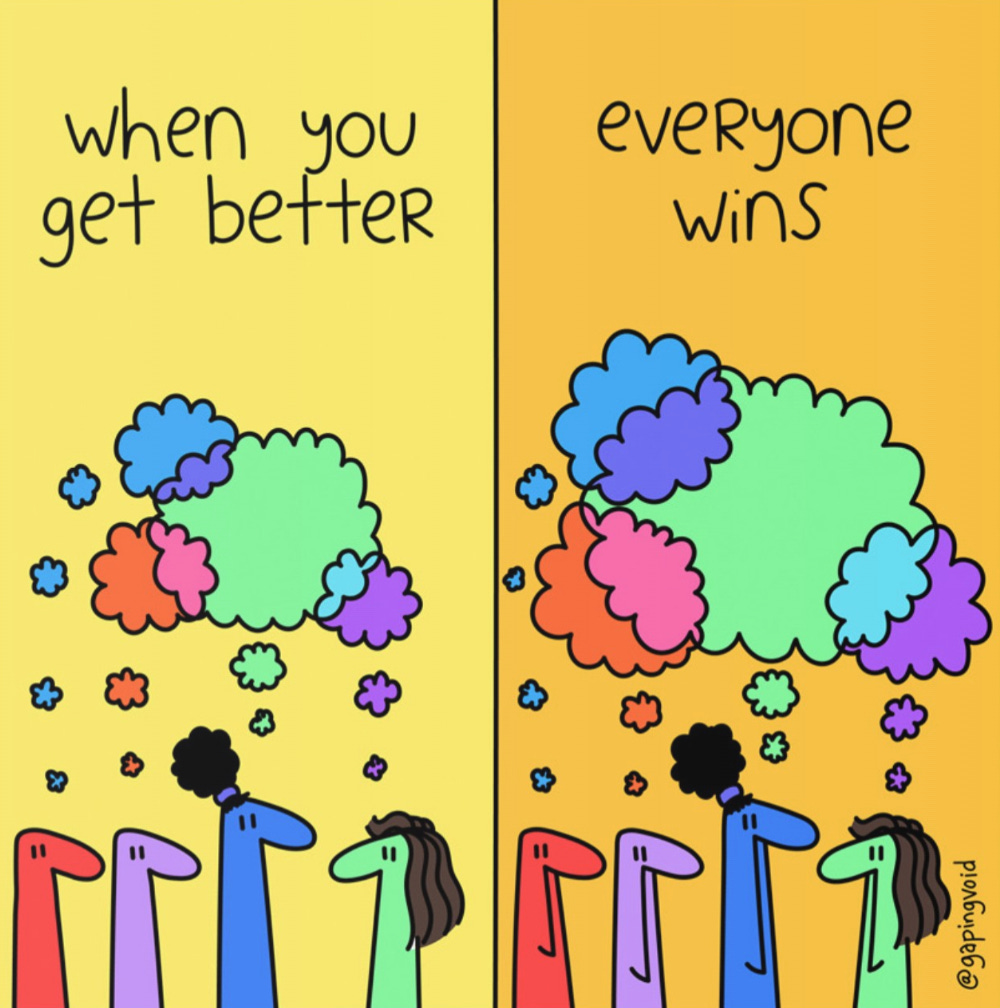
I’d gone to a conference called the Global Leadership Summit, and something the host said from the stage stuck with me: Everybody wins when a leader gets better. I looked at my own calendar after that and saw a blank where leadership development was supposed to be.
So, I had a choice:
I could throw a pity party about how nobody’s mentoring me, the district doesn’t care, and there’s no support for people like me.
Or I could take control.
Shortly after, I started a podcast. I’d interview people who knew more than me, do my learning in public, and close my own leadership gap one conversation at a time. Without knowing it, I was practicing Selfmentorship before it had a name.
The school leaders who practice Selfmentorship build a future that outlasts them.
They grow themselves and those around them.
For example, Gene Park used a framework called Sticky Core Values to help staff, students, and parents actually know (and own) what his school stood for. He didn’t use the laminated-poster version of values. He used language that the community helped shape. Staff, students, and parents knew the values. And when Gene started reworking his school’s intervention system so every student could get the support they needed, that same culture of shared ownership made the work possible.
Scott Long also did Sticky Core Values, and his science teachers built a whole unit around it. Students grew marigolds in class as a living expression of the school’s values. He went from assistant principal to principal to assistant superintendent, and the work he started on one campus kept rippling.
Demetrius Ball became a principal at a middle school, then a high school in Northern California. He looked at what kids in the English department were reading and pushed for a more diverse curriculum that reflected their experiences. He built a student wellness center so kids had somewhere to go when they were wound up and struggling, before discipline became the only option. When the superintendent visited, multiple teachers walked up to say he was the best principal they’d ever worked for. In 2025, he was named the Administrator of the Year for Region 6 in California.
Doc Chris Jones (Doc, for short) pulled off a socially distanced prom for his seniors at Gillette Stadium during COVID, when most schools had canceled everything. He’d also gotten rid of finals, not because finals are automatically wrong, but because he’d decided his campus needed to be more focused on learning in real time than on a single high-stakes test at the end of the year. He has since launched a podcast, become a national speaker, and published books. In 2022, he was named the Massachusetts School Counselors Association (MASCA) Administrator of the Year.
None of these leaders had a better system handed to them or were in perfect districts. What they had was a decision that their development was their responsibility. And that decision unlocked everything else.
Look closely at these leaders, and you’ll see the same traits:
They are empathetic and generous with their staff and students. But they don’t come to campus with a fixed, top-down definition of what’s best for kids. That definition gets built with the community, and they hold people accountable to it together. That’s a subtle but important thing. Leaders who develop themselves tend to stay curious. They keep asking. They don’t arrive with all the answers.
They aren’t hurried. There’s a difference between urgency and busyness, and the best Ruckus Makers know it. They’re productive and purposeful. They know the difference between handling what’s in front of them and leading into the future.
They author their own game. Play-It-Safe Principals work inside someone else’s rules. The handbook and precedent exist. When a hard situation comes up, there’s a page to turn to. That system has knowledge, but it also has limits. Leaders who operate within those limits will only ever get what the system was designed to produce.
Ruckus Makers Do School Different, and there’s no manual for that. So they build their own, one decision, one conversation, and one year of growth at a time.
That’s Selfmentorship, and it starts with a decision you can make right now.
How to Develop a Selfmentorship Practice
Deciding that your development is your responsibility is the first move.
Once you make that decision, you face a second problem: Nobody ever showed you how to develop yourself. The system trained you to wait for external triggers. You’re rejecting that, but now what?
Selfmentorship isn’t self-improvement for its own sake. It isn’t a morning routine you white-knuckle through for two weeks and abandon. It’s a set of practices you build into the rhythm of your leadership, so growth stops being something you fit in when the calendar allows and becomes how you normally operate.
Here are five practices that Ruckus Makers use.
1. Look into the Accountability Mirror
Like most leaders, you already know your gaps.
The problem isn’t that you lack self-awareness. The problem is that naming what’s hard (out loud, to yourself) feels like failure. So, you stay vague. You tell yourself you’re working on it. You stay busy enough that you don’t have to sit with it.
The Accountability Mirror is simple:
What am I struggling with right now, and am I willing to say it clearly?

You don’t want to do this in a self-flagellating way, so don’t list everything wrong with you. Just get a clear-eyed look at where you are. One leader I work with, Justin King, went through this and landed on something that changed how he ran his whole week: I no longer see more hours as the solution. Once he named that gap, he started closing it. Justin’s first move ? He left at 5pm. Every day. The work wasn’t done, but he made a decision that presence at home mattered more than one more hour at school. His staff noticed. The culture shifted.
Selfmentorship is being honest about where you are right now.
2. Build a Daily Reflection Practice
A lot of school leaders are great at reflecting on everyone else. They debrief their teachers. They think about the student experience. They process hard conversations with staff.
How often do you debrief yourself?
A daily reflection practice is not navel-gazing. It’s the only way you start to see your own patterns. Over time, it becomes a personal playbook that’s specific to you, your campus, and your leadership.
For example, here’s what my daily reflection looks like:
In the morning, before the day takes over, I use Dan Sullivan’s D.O.S system to ask:
What dangers must I look out for today?
What opportunities must I capture?
What strengths do I want to build on?
What are my Big 3 things that matter today?
At the end of the day, I reflect on:
What new thing did I do?
What worked and what didn’t?
What did I learn?
What’s one thing I’ll do differently tomorrow?
Every week, I review my goals and ask:
What progress did I make?
Am I happy with that?
What do I need to focus on next week?
Monthly, I zoom out:
How am I doing on my leadership development?
What do I need to keep growing?
How will I get meaningful feedback?
I also keep an EPS Journal (Effort, Progress, Success) based on Dr. Nate Zinsser’s book The Confident Mind. The idea is simple: track what you’re putting in, what’s moving, and what’s working. Do that consistently, and you run on data about yourself.
Do this every month, and you build a personal playbook for your school.
Skip it, and every year feels like your first year.
3. Find Your Mirror People
A mentor is great, but you can’t wait to be assigned one.
Mirror People are the people in your life who know you well enough to tell you the truth, especially the hard truth. These aren’t yes people or the ones who tell you what you want to hear. They’re the ones who push back, who ask the question you were hoping nobody would ask, and who care more about your growth than your comfort.
When someone holds up a mirror and shows you where you need to change, you can’t run from that reality.
You build your Mirror People network the same way you build anything: intentionally.
You don’t wait for a district to assign you a coach. You go looking for people who are doing interesting work, having hard conversations, and growing in ways you want to. You reach out. You show up. You give as much as you take.
Personally, I started building my group of Mirror People when the local school leadership dinners didn’t work. I went digital and national by starting a podcast, creating a Mastermind, and having conversations with leaders across the country. Kory Kane built his group of Mirror People by showing up to every call, doing the work, and using every available resource (including Digital Danny as a thinking partner). The form your Mirror People take matters less than the decision to build it.
Don’t wait to be assigned a mentor. Build your mirrors.
4. Expand Your Inputs Beyond Education
The education echo chamber is real.
You stop getting new ideas when everyone you read, everyone you follow, and every conference you attend is talking about school leadership. You get variations on the same ideas. Your thinking narrows without you noticing.
That’s why the leaders in my Mastermind program intentionally don’t read education books. Because the leaders who grow the most tend to be the ones with the widest input. So, we read about psychology, architecture, restaurant culture, military strategy, and behavioral economics. We go to events outside of education. We surround ourselves with thinking that has nothing to do with schools, yet find that almost all of it applies.

Here are a few books we’ve read over the years:
Essentialism by Greg McKeown: The disciplined pursuit of less. If you want to protect time for your own development, this is where to start.
Deep Work by Cal Newport: How to do the kind of focused, high-value thinking that actually moves your campus forward, in a job designed to interrupt you constantly.
The Culture Code by Daniel Coyle: What the best teams in the world do to build trust and shared purpose. Applies directly to every staff meeting you’ll ever run.
Dare to Lead by Brené Brown: Courage, vulnerability, and what it takes to lead people through hard things without losing them.
Never Split the Difference by Chris Voss and Tahl Raz: A former FBI hostage negotiator on how to have high-stakes conversations. Every difficult parent meeting, non-renewal, and union conversation gets easier after this one.
Stillness Is the Key by Ryan Holiday: On slowing down enough to think clearly. The antidote to the culture of busy.
The Power of Moments by Chip and Dan Heath: Why certain experiences stick and others disappear. Useful for anyone trying to build a campus culture worth showing up for.
Thinking in Bets by Annie Duke: How to make better decisions under uncertainty with incomplete information. Which is every decision you make as a principal.
Man’s Search for Meaning by Viktor Frankl: The one book on this list that will make you reconsider every complaint you’ve ever had about your job. And then make you better at it.
Caste: The Origins of Our Discontents by Isabel Wilkerson: If you’re building a campus where every kid belongs, this belongs on your shelf.
The Promises of Giants by John Amaechi: A book that challenges each reader to consider the responsibility and impact of leadership on an environment.
If you approach Selfmentorship this way, authors become mentors. Podcasters become thought partners. A book about how a hospital redesigned its culture can teach you more about your school’s personal development problem than most educational personal development ever will.
Get outside the education echo chamber, and your campus will feel the impact.
5. Design a System for Your Own Development
Without structure, personal development becomes random.
Random development is what you already have. A good book here, a great conversation there, a conference once in a while. None of it compounds because none of it connects.
A smart system makes Selfmentorship compound.
One tool I come back to is the Harada Method—a 9x9 grid with your super goal at the center, eight life pillars around it, and eight concrete supports under each pillar. You look at it every day to remember what matters to you, underneath all the noise. (You can get a free Harada Method template here.)
Pair that with a powerful question from the book The ONE Thing:
What’s the one thing I could do today that makes everything else easier or unnecessary?
Play-It-Safe Principals have a long list and feel like they’re losing every day because it never gets done. Ruckus Makers also have a long list, but they know their one big thing.
Start there, every day.
You are the chief opportunity and the chief bottleneck in your organization. Your school can only grow as much as you’re willing to grow. That’s actually good news because it means the lever is in your hands. You don’t need the district to schedule it. You don’t need a coach to show up. You don’t need the calendar to clear.
You just need to start.
Using AI as a Reflective Mirror
There’s one more tool worth naming as you begin Selfmentorship: AI.
AI won’t replace your Mirror People. It won’t replace the Mastermind or the books or the daily reflection practice. But for a lot of Ruckus Makers, it’s become the tool that ties everything else together because it’s available at 11 pm when a teacher just quit, and at 6 am when you’re trying to think through a hard conversation with a parent before the building opens, and every moment in between when you need a thinking partner and there’s nobody around.
Specifically, AI built for school leadership.

Kory Kane’s 910 conversations didn’t happen because he had a lot of free time. They happened because he found an AI tool that could meet him exactly where he was when he needed it, and help him think more clearly about whatever problem was in front of him.
When I asked him what the emotional outcome of a good session felt like, he didn’t say relief or confidence. He said momentum.
“It helps clear your mind. You’ve had all these thoughts and ideas, and now you have a direction. You can start making momentum with where you want to go next.”
That’s what a good thinking partner does, and it’s what AI can do for your Selfmentorship practice if you know how to use it.
As a school leader, you can use AI for 4 jobs:
1. Think it through. Something lands on your desk, and you’re not sure what path forward makes sense. You need to talk it out to weigh the options, surface what you might be missing, and get out of your own head. This is the coaching conversation you don’t always have access to. AI can hold that conversation with you at any hour, without judgment or an agenda.
2. Apply a tool or framework. Over a decade of working with school leaders, I’ve built a library of tools for culture, communication, and leadership development. The problem most leaders have isn’t that the tools don’t exist. It’s knowing which one fits the situation in front of them. Describe the problem, and a well-trained AI can pull the right framework and walk you through applying it.
3. Challenge the story. Sometimes you’re not stuck on a decision—you’re stuck in a perspective. You’ve decided how something is going, and you need someone to push back, ask the question you haven’t asked yourself, and show you the 30,000-foot view. A good AI tool will reframe the situation without telling you what to think.
4. Communicate it. You know what needs to be said, and the message is clear in your head. But this one matters (a teacher non-renewal, a hard parent conversation, a high-stakes message to staff), and you need it to land. AI can help you find the words and anticipate how it will be received before you reply.
Those four jobs are what Kory was hiring Digital Danny to do, even before the tool was trained to do them well. He figured it out himself by showing up and doing the work.
A note: If you want to go deeper on how to use AI as a Selfmentorship tool (with specific prompts, examples, and workflows), keep an eye out for the next mini-book.
The gap between what the school system offers and the development you need is massive.
Kory closed that gap by using every tool available to him. AI was one of those tools. As a school leader, it can be a significant one because it makes development work possible on days when your schedule is packed. Even a 5-minute thinking session with AI can help you work through a problem or teach you how to respond more clearly.
AI is a guide along the way, where you’re still doing the work.
You Can Transform From Permission-Based Development To Selfmentorship
One misconception keeps a lot of school leaders stuck.
They look at the Ruckus Makers—the ones doing transformational work on their campuses, growing their careers, building something that lasts—and they assume those leaders got lucky. Someone handed them the path. They were chosen, had the right district, or started with advantages that made the difference.
That’s not what happened.
Being a Ruckus Maker means having consistent, daily, radical ownership of your own development. Taken seriously over time, that kind of ownership creates its own luck. It opens doors. It builds the instincts, relationships, and reputation that make opportunity possible. But it starts with a decision, not a circumstance.
Nobody is coming to hand you the path.
Personally, I found this to be the most empowering mindset because it means you don’t have to wait. The leaders you admire didn’t wait. They decided their development was their responsibility and got to work.
You can make that decision right now.
You can honestly look at your gaps instead of staying busy enough to avoid them.
You can build a daily reflection habit that compounds into a personal playbook.
You can find the Mirror People who will tell you the truth.
You can expand your mind outside the education echo chamber.
You can design a Selfmentorship system that makes your growth intentional instead of accidental.
You can use every tool available to you (books, conversations, AI, and community) to become the leader your campus needs you to be.
You can practice the art and science of Selfmentorship.
The leaders who practice it end the year asking great questions, building toward something bigger, and ready to go again.
That’s the Ruckus Maker difference. You can create a campus experience worth showing up for—for your students, your staff, and yourself.
Don’t wait to be chosen.
Choose yourself.
– Danny, Chief Ruckus Maker
If this landed for you, here are a few ways to keep going.
Try Digital Danny in the Selfmentorship Sprint on April 30th, 7-8pm ET. This is a live 1-hour group experience where you’ll learn how to use Digital Danny—the school leadership AI built on a decade of frameworks and coaching—as a daily Selfmentorship tool.
Here’s what we’ll cover:
A short teaching on Selfmentorship and why it matters for your campus
A live demo with a school leader working through a problem
A 10-prompt pack to get you started using Digital Danny
Time to use Digital Danny for yourself, plus a Q&A
You’ll leave with 30 days of access to Digital Danny and a thinking partner available every hour of the day. Learn more and sign up here.
Listen to the Better Leaders Better Schools podcast. You’ll find over 10 years of conversations with the most interesting people doing the most interesting work in school leadership. Every episode is a Mirror Person who knows more than you about something you care about. Start anywhere.
Keep an eye out for the next mini-book. This one named the Selfmentorship practice, and the next one goes deep on how to apply it using AI. I’ll share specific prompts, examples, and a workflow for using Digital Danny AI as a daily Selfmentorship habit.