

👋 Welcome to Ruckus Makers the home of Selfmentorship. We write for leaders who are done waiting for the system to develop them and have taken radical control of their growth. If that’s you, then subscribe below and you’ll know the moment a new mini-book drops ⚡️
Chapter 4. Lead Your Remarkable School
When my friend, Joe Clausi, moved across the country for his first principalship, he had no idea that the charter school he would be leading was failing. The school itself was only two years old, but it was already struggling. The only charter school in the district, it had been founded to focus on career and technical education, offering classes in construction, engineering, and architecture—all careers that made sense for the local community.
When Joe arrived, he learned that the school wasn’t even accredited and had acquired a negative reputation. It had become the school where kids were sent after being expelled or suspended from other schools in the area.
For the first year, Joe focused on making several immediate, necessary changes to turn the school around. He let many of the former staff go and hired new staff, overhauled their block scheduling, and changed the grading system. In his second year, the school applied for accreditation. During the review committee’s visit, the committee chair pulled Joe aside and praised him for all the progress they had made.
“But,” the chair added, “You don’t have a long-term vision for the school. I’m going to challenge you now, and when we come back in five years, that is what we need to see.” He told Joe that they needed to have a clearer vision of their ideal student, a profile of a graduate, and more rigor.
Joe realized the chair was right. They had been working so hard just to put out the proverbial fires, but they had no overall vision or direction for improving the school beyond that. They were still an afterthought in the community, despite having improved.
After that meeting, Joe got his team together to talk about their strengths. What could they do to up the level of rigor and offer a truly unique and exemplary learning experience?
They first considered providing Advanced Placement (AP) classes. But they quickly realized that most other schools in the area offered the same thing; they didn’t want to fit the mold of every other school. Instead, they looked for another option that would lean into their unique focus on vocational and technical education.
One teacher suggested they look into the International Baccalaureate® Career-Related Programme. The whole team was excited to see that it offered a rigorous curriculum and fit perfectly with their hope to provide relevant, real-world experiences for their students. Plus, no other school in the entire state was doing this program. They would be the first.
As they began the two-year authorization process, Joe realized that the teachers would have to collaborate more in order to achieve their goal, so he gave every teacher a collaboration period to work with each other. They built relationships with businesses in the community so that students could apprentice with professionals and graduate with real-world experience. They added classes in computer science, design, and robotics—years before this became a trend. Their scores in the core disciplines improved, along with their reputation in the community. Over time, the school became a place where students wanted to be.
When Joe talked to the committee chair again, he shared what they had done. The chair nodded his head and said, “That’s it. You’ve got it.”
Have you ever been in a situation like Joe’s? Have you ever felt so overwhelmed by all of the challenges in front of you that you couldn’t think about what to have for dinner tonight, let alone a long-term vision for your school’s success?
It’s easy to get caught up in the day-to-day planning. That’s why you need to retreat to regain perspective and discover where you need to go next.
In this chapter, we’ll help you create a vision as inspiring and empowering as the one Joe and his team created.
Reflect: Visualize Your Remarkable School
Imagine it’s three years from today. You’re walking around your school with a notebook in your hand. And while you’re walking through your school, I want you to capture everything that you see and everything that you hear. Capture everything that you can experience with your senses and write it down in your journal or in the space below.
Remember, go crazy with it! Dream big. Don’t censor yourself or worry about what others will think. Right now, no one else is here. This is your vision for your Remarkable School. Don’t create an upper limit where none exists.
Remarkable School Vision List
Now that you’ve got a general vision for your Remarkable School, let’s get more explicit and dream about the details with the Remarkable School Vision List. Just like we built our Dream 100 List around a number of categories, we’ll do the same thing for our Remarkable School.
Most schools don’t think about vision with an eye toward the specifics. Most schools create a “vision statement” that’s usually too vague and general to be truly meaningful and useful.
The mistake here is that school administrators think a generic vision sounds right but it couldn’t be more wrong. By not taking a position, by not getting specific, by trying to please everyone, you’re setting yourself up for a mediocre vision at best. The value is in getting more specific and defining your expectations. It’s via specificity that you can actually start to see a path toward your Remarkable School.
You don’t have to fill out all of the reflections right now, but do take some time to read through them and envision what changes you’d want to see in your school for each category. These are the categories that I start with for dreaming up my Remarkable School Vision, but you might think of more. Feel free to expand and add as many categories as you need. This is your vision, after all!
Reflect: Ideal Week
Imagine it’s a perfect week at school. Now respond to the following questions using the space below or your own journal:
● How are you spending your time?
● What gets done every day?
● What is your number one priority?
Reflect: Sticky Core Values
Here’s a secret I learned about core values: If you can connect your values to the aspirations of your community, you’ll have a powerful combination and others will love your Remarkable School Vision.
Sticky core values aren’t what we typically think of as our values; they’re not just a word like honesty or integrity. Instead, they’re a phrase that embodies how you and your team want to show up.
Former principal Scott Long heard about sticky core values on an episode of the Better Leaders Better Schools™ podcast and decided to try it out with his elementary school staff at the time. The team had created a collective social contract that listed several values they wanted to embody, but Scott wanted it to be more than just a list of words on a document. He wanted their values to be memorable, meaningful, and fun.
The value that stood out to him the most from their social contract was supportive. Scott wondered if there was a better phrase that embodied the culture of care, accountability, and willingness to help that everyone loved about their school.
As a fan of the movie, Rocky, he thought of the scene where the character, Mickey, Rocky’s coach, gives him a cufflink on a chain. Mickey says that the cufflink would be like an angel on Rocky’s shoulder, always reminding him of Mickey’s love.
That’s how Scott thought of his school’s community, too—that everyone was like an angel on each other’s shoulder, helping each other out and reminding each other of what’s important. “Rocky’s Cufflink” became Doherty Elementary’s first sticky core value.
In Chapter 5, we’ll share more about what Scott did next to get his team excited about their sticky core values and create more of them. For now, consider the following questions and write down your responses below or in your journal:
● What values does your staff share?
● How would you describe the culture at your school?
● What values do you want to see (and does your team want to see) reflected at school?
Reflect: Learning
You probably know by now that I’m very committed to the idea of getting better together through mentoring, coaching, and masterminds. I know it works, too, because I’ve seen the impact firsthand in my own life and in the lives of the people in my mastermind.
Remember, when YOU get better, everybody wins.
Respond to the following question in the space below or in your journal: How do you want to invest in your own learning?
Reflect: Reputation
Consider the following questions and write your responses in the space below or in your journal:
● What do you envision people saying about your Remarkable School? What’s the buzz?
● What are people in the community saying? What do the parents think?
● What does your staff say when you’re not around?
● Are you getting any media coverage?
Reflect: Edges
Your school’s edges are the unique qualities and strengths for which you decide to go all-in. For example, you might decide to go all-in on being a STEM campus versus trying to invest in several different programs to meet various student needs and interests.
You’ll never be able to make everyone happy, so instead of trying to do lots of things (and doing them poorly), make decisions about a few things you want to go all-in on and do really well. For instance, your edges might be focusing on project-based learning, SEL, or PBIS—but not all of those initiatives.
Respond to the following question in the space below or in your journal: Where do you want to focus your team’s energy?
Reflect: Culture
Consider the following questions and write your responses in the space below or in your journal:
● What do you see in your Remarkable School’s culture?
● How do people make others feel welcome?
● What makes your school unique?
● How will you surprise and delight the people in your school?
Reflect: Ideal Team
Speaking of the people in your school, take a minute to dream about your ideal team. Who do you need on your team? Maybe you’re thinking of some open positions that need to be filled right away, but also think about the qualities of the people you’re looking for. What’s important to them? What are their personality traits? What is their character?
Moreover, what do you need to do to attract these people or grow these qualities in the people you have? What new programs could you offer to help them?
Write your responses in the space below or in your journal.
Reflect: Brand Promises
We don’t usually think of our schools like a business, but it’s true that every school is a brand as well. Brands make promises and declarations about what they offer to their customers—in this case, your students and teachers.
If your school doesn’t yet have a strong brand, your brand promise could be an aspirational statement about what you want your students and teachers to experience there.
In the Better Leaders Better Schools™ mastermind, we have four brand promises:
High-quality leadership training for innovative leaders with a bias for action
Instantly plug into a powerful network of school leaders that operates like a grassroots organization
A place where you can talk about what you need to talk about without fear of consequences or judgment
Learn from the best leaders across industries and apply those lessons to your leadership practice in education
So imagine that you had to market your Remarkable School to your teachers and students—as I’m sure you’ll have to do! What brand promises do you want to make? Record your responses in the space below or in your journal.
Create a Mind Map
I love to go visual when I’m being creative because it helps me think more expansively. You can create a mind map using sticky notes, or just doodle one in your journal. There are also great mind mapping softwares available for free online if using technology is your jam.
Here’s an example of how I started mind mapping my Remarkable School Vision:
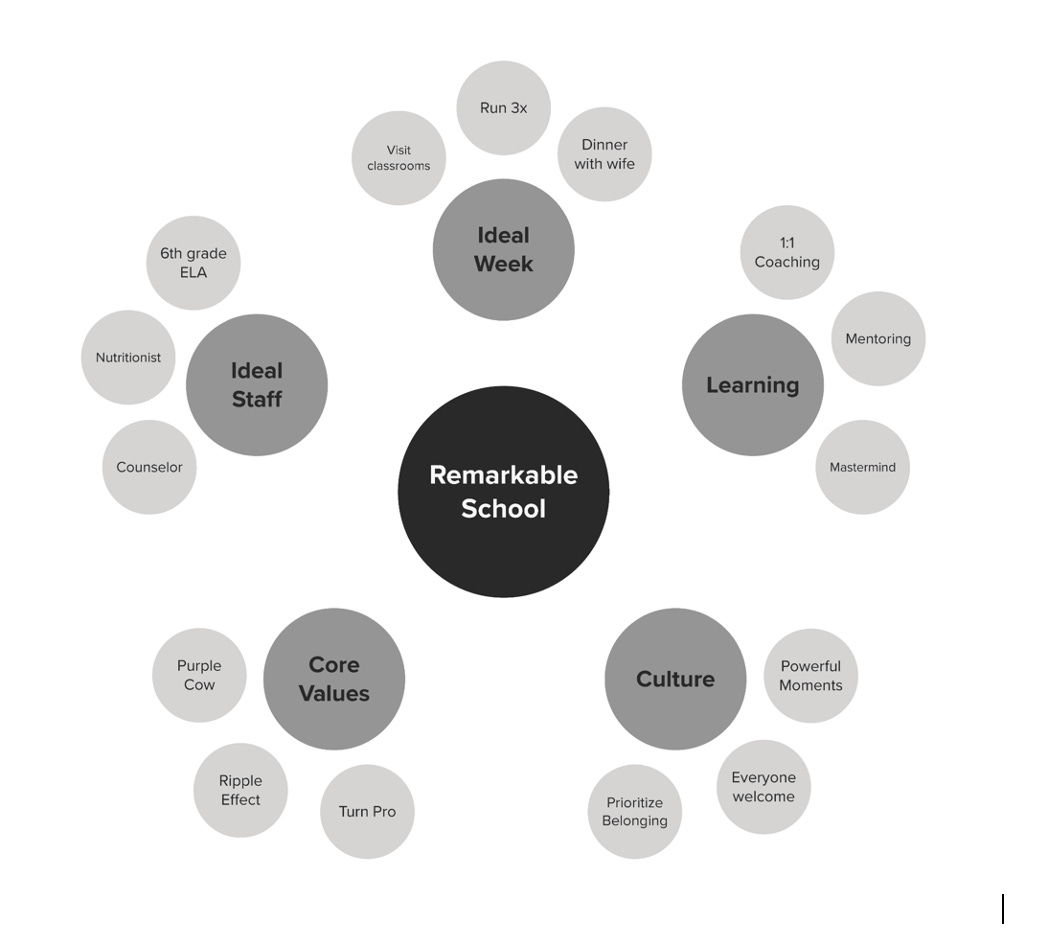
The amazing thing about your Remarkable School Vision is that it can be whatever you want. Often leaders tell me that when they started doing this exercise, they didn’t realize how emotional and vulnerable it would be. It’s actually harder than you might realize to let yourself dream because, if you’re like most people, you spend so much time limiting yourself. But when you finally embrace the total freedom of this exercise, it can be humbling and awe-inspiring.
On this retreat, you’ve now dreamed up your Remarkable Life, Remarkable Family, and Remarkable School. Your vision will probably change—in fact, it should change as you get feedback and incorporate the visions of the people around you. In Chapter 5, we’ll talk about how to do the last two steps of the Remarkable Vision Formula: Seek feedback and implement the vision.
Chapter 5. Spark Change With Remarkable Execution
In Chapter 1, I shared the quote from the book of Habakkuk: “Write the vision, make it plain on tablets, so he may run who reads it.” You’ve got your vision. You’ve made it plain. Now, let’s get ready to run.
Seek Feedback
Ruckus Makers know that although they start with themselves—their own self-care, their own vision—they don’t take action before they’ve included the others in their circle and received feedback so that it’s everyone’s vision, not just their vision. You can take the first step of dreaming and imagining something better, but in order to make that vision a reality, it has to be a vision everyone in the community shares.
In order to start getting feedback on your vision, use the concentric circle method.
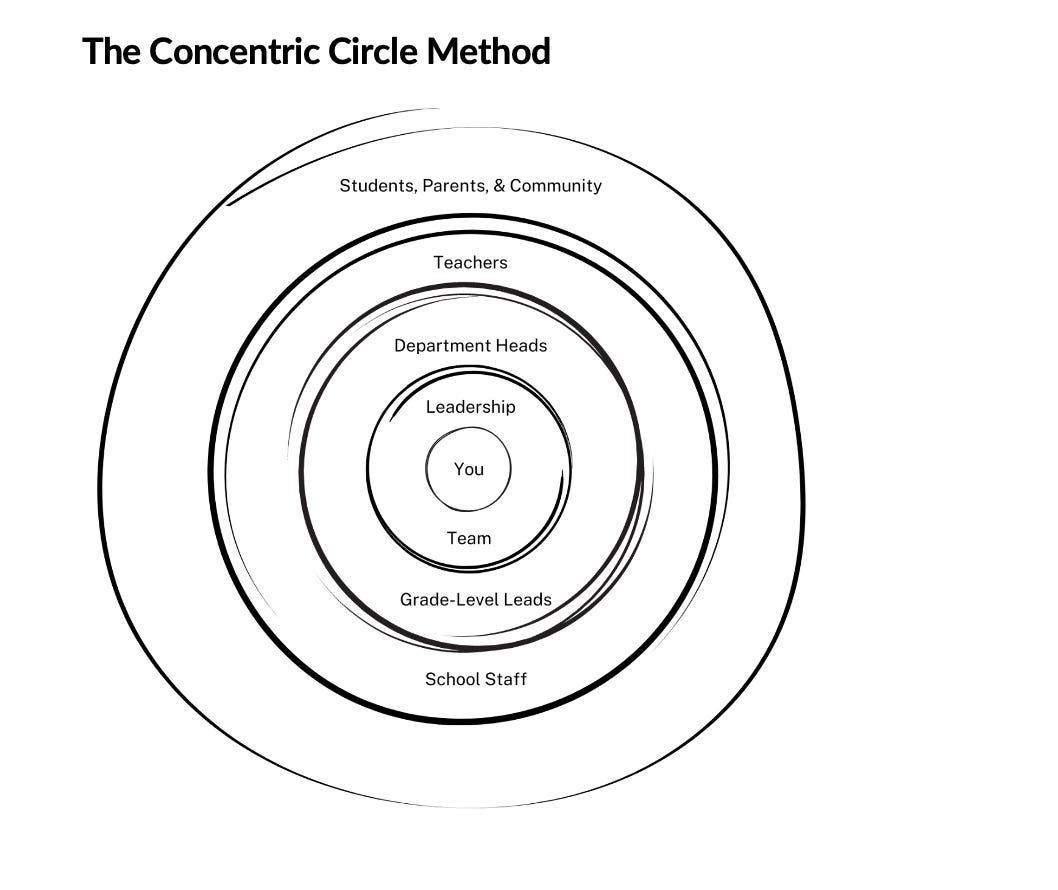
In the concentric circle method, communication about your Remarkable Vision should flow outwards through the hierarchy from you to your students, their parents, and the broader community.
I don’t know about you, but often when I’m journaling and brainstorming, the end result is a chicken-scratch mess that no one but me could possibly figure out. You might need to write out your vision in a way that’s more readable and cohesive before you start sharing it.
When you’re ready, the first people you should send it to is your leadership team. This group includes the people you trust to make decisions and represent the broader school community. Ask them to take a look at your “IN-PROGRESS DRAFT” vision. (The all-caps is important for overemphasizing that this is a draft and you want their input.)
It’s likely that this group will have the most feedback for you because they’re the most comfortable with you and they’re the first ones to see your earliest thinking. Get ready to make lots of edits. Better yet, after the leaders have had a chance to review the draft, schedule a qualitative discussion about it and collaborate to create a newer, better version.
Once you have a version that your leadership team is pretty happy with, have them take ownership of it, personally send it to the department heads in your building, and repeat the review process. Support them with any messaging or accountability they need in order to get timely input from everyone involved. Overcommunicate (again and again and again) that this is a draft.
Once your leadership team has gotten feedback and come up with the next iteration, have the department heads share it with all of the teachers in their respective departments. Offer to help them in any way you can. Oh, and by the way, have I mentioned that they need to know this is a draft?! That said, the hope is that, by this point, your vision will have already been fleshed out and edited to the extent that most people align with it.
The outward-most circle includes your students, their parents, and the broader community. This message is best coming from you, but enlist your teachers and other staff to help reinforce it for everyone so that it’s clear this is a school-wide endeavor and everyone’s on board with this vision. Still, you should make it clear that this is not the final product and that you want students’, parents’, and the community’s opinions on the collective vision for a Remarkable School. At this point, yes—it’s still a draft.
That said, it can’t be a draft forever. You could perpetually postpone action by nitpicking the right words or bickering over priorities. According to author Ryan Holiday (2022), “What you don’t ship, what you’re too afraid or strict to release, to try, is by definition a failure. …We have to be brave enough to soldier on” (p. 132–133).
With each circle of feedback, give people a short and firm deadline to have input back to you. After the deadline, it’s time to move on to consolidating the feedback and sharing the vision with the next circle. If there are any debates or stand-offs between people’s opinions, you’ll need to make a choice and help everyone move on. Remember, some progress is better than none.
You’re the leader. This is what you’re here for.
The Vision for Sticky Core Values
Scott Long’s process for sharing his vision for sticky core values at Doherty Elementary School is a great example of how he built buy-in with his team. Scott heard about the idea and created the first one, Rocky’s Cufflink, on his own. But then he had to get everyone else on board.
First, he created curiosity with a hook. The whole idea of sticky core values is that they’re memorable and meaningful—and Scott wanted to make sure the process of creating them was memorable, too. He posted flyers around the school building—in the staff lounge, on teacher’s computers, next to teacher mailboxes—and sent the flyer to the staff via email. It had pictures from the scene in Rocky where Mickey gives him the cufflink. Scott says:
Out of nowhere, I was asking staff to determine what these images had to do with the Doherty Family. The challenge was cryptic yet simple: Post a video on Flipgrid that predicts how these images from Rocky related to our staff. The person with the most accurate guess would receive a prize at our next PD, and the true answer would be revealed during this time.
When staff arrived at the PD, they discussed the Doherty social contract and shared their thoughts on what it meant to be supportive: active listening, sharing resources, taking an interest in each other’s personal lives, holding each other accountable, and asking others if they need help.
Finally, Scott presented the winners of the Flipgrid challenge and explained the purpose of their PD.
They watched the scene from Rocky, and Scott clarified the idea of sticky core values, revealing the first value of Rocky’s Cufflink. He invited them to submit another Flipgrid video sharing a story of how another staff member was demonstrating Rocky’s Cufflink.
After the PD, Scott sent an anonymous survey to the staff, inviting them to offer feedback. These are the results:
Used with permission from Scott Long.
With consensus from the majority of the staff, Rocky’s Cufflink was officially adopted.
A month later, the staff came together again for their final PD session of the year. They grouped into grade-level teams, and Scott challenged each group to choose a value from their social contract and turn it into a sticky core value.
Part of the assignment was to explain the meaning of the phrase, tell a story about it, and draw an image or symbol for it. From there, the staff voted on their favorite sticky core values. They decided on three more together:
● All Hands In: This sticky core value emphasized that they are “all in;” that they are fully committed to their goals and to each other.
● Find the Marigold: Marigolds bloom where they’re planted; to the team, this symbolized the positivity and optimism that they wanted to bring to their school and the students they served.
● R.E.S.P.E.C.T.: One teacher at Doherty was a singer in a rock-and-roll band, and Aretha Franklin’s classic song was one of her favorites. They decided that there was no better way to remember this important core value.
Implement the Vision
There’s an ancient Japanese proverb that says “vision without action is a daydream. Action without vision is a nightmare.” Once you have buy-in on your Remarkable Vision, you’re halfway there. Now it’s time to put it into practice.
Four Pitfalls to Avoid
It’s at this point that I often see progress at schools stall in one of four ways:
They do nothing. Everyone pats themselves on the back for coming up with a beautiful vision, and then they go back to their lives. The habits they’ve held for years take over again, and it’s as if those conversations about vision never happened. In my opinion, this inertia is the biggest threat to implementing your vision.
They do everything. At the other extreme are the schools and leaders who push to accomplish everything all at once. The key to successful implementation is segmentation—breaking the vision down into smaller steps and milestones, setting deadlines, and making our way slowly but surely.
They do it alone. It’s easy for leaders to get caught up in trying to make something happen on their own, which leads to siloing, isolation, and burnout. Dan Sullivan, in his book, Who Not How: The Formula to Achieve Bigger Goals Through Accelerating Teamwork, teaches that instead of asking, “How can I accomplish this?”, we should start asking, “Who can help me achieve this?” (Sullivan, 2020, pp. 7–8).
Wise leaders know that having support from their team and from peers (like we do in the Ruckus Maker Mastermind) will make it so much easier to accomplish their goals.
They communicate poorly. Some leaders make the mistake of communicating poorly about the vision. Most often, they say it once and then fail to follow up or reiterate it in other modes of communication—which results in doing nothing. As Jeff Weiner (2020), former CEO of LinkedIn, said, “You need to repeat yourself so often that you get sick of hearing yourself say it. And only then will people begin to internalize it.”
Or leaders might downplay the vision and fail to make it inspiring and relevant to everyone in the community. They end up sounding like the teacher in Charlie Brown: “Wah wah wah.” It’s hard for people to take action on a vision if they’re already asleep!
Let’s learn how to avoid these common pitfalls by following the four steps to implementation.
Four Steps to Implementation
Communicate effectively. Ruckus Makers who are excellent communicators make their vision obvious and visible to the entire community. They share it with the team, post it publicly online, and talk about it in meetings.
Not only that, they also know how to recreate for others the same passion and excitement they felt while drafting the vision. That might even mean leading your team on a visioning retreat together (and if you’d like help with that, please reach out! My team would be honored to facilitate this experience for you).
Have a bias toward action. In an article, “How to Manage Through Chaos,” Jim Collins and Morten T. Hansen (2011) tell the story of the epic race to be the first to reach the South Pole. It was 1911, and the two competing teams were led by Roald Amundsen and Robert Falcon Scott. The trip would be over 1,400 miles with temperatures often dipping below -20 degrees Fahrenheit and sometimes fierce winds as well. Each group of explorers faced the same challenge, but they tackled it with vastly different strategies.
Amundsen’s group committed to covering 15 to 20 miles per day no matter what. Rain or shine, warm or frigid, wind or calm—they would be traveling 20 miles every day. Scott’s group, on the other hand, decided to press their advantage whenever they could—pushing themselves to exhaustion on the good days and then taking breaks to wait out bad weather.
Amundsen’s group made it to the South Pole right on time, averaging 15.5 miles per day (Collins & Hansen, 2011). Scott’s team showed up 34 days later, having lost five men, including Scott himself (“Comparison of Amundsen and Scott expeditions,” 2023).
Collins and Hansen call this idea of committed progress “the 20-mile march.” It’s about taking small steps every day that get you closer to your goal, no matter what obstacles stand in your way. Aesop’s Fables tells a tale about the tortoise and the hare that teaches the same lesson. Focus on taking whatever actions you can toward your vision, and be patient with the results.
Measure what matters. Segmentation is the key to success. Break your vision down into smaller milestones that can be measured. For each part of your vision, set three-to-five objectives that you want to accomplish—no more. Then, for each objective, identify three-to-five key results you’d like to see.
I do this everyday by identifying three tasks aligned with my vision that I want to accomplish that day. Of course, I would love to be able to do more than that, but I don’t count on it. Instead, I just keep score on whether or not I achieved those three tasks.
For example, if one piece of your vision is a culture of belonging, then here are the objectives and key results you could put into place:
Objective: Make everyone feel welcome on the first day of school.
Key Results:
1. Greet all students getting off the bus.
2. Visit every classroom to personally say hi and encourage teachers.
3. Acknowledge every person I see within the walls of my school.
Objective: Stop the bullying occurring during the second lunch period.
Key Results:
1. Lead a “belonging and othering” discussion at next PD day.
2. Empower teachers to do the same exercise/discussion with their classes.
3. Sit and talk with students during second lunch; be present and visible.
Objective: Create powerful moments.
Key Results:
1. Hold a 100-day celebration assembly.
2. Bring a cake, donuts, or another favorite treat to put in the teacher lounge for each teacher’s birthday.
3. Solicit student feedback about teachers who are doing great things, and give them that feedback at the next PD meeting.
Intentional celebration. The late Tony Hsieh, founder and CEO of Zappos, said in an interview for The New York Times: “We really view culture as our number one priority. We decided that if we get culture right, most of the stuff… will just take care of itself” (Bryant, 2010). One of Zappos’s core values is to “create fun and a little weirdness.” They take fun seriously, and it’s one of the reasons their company has been successful. Can you imagine what would happen if schools took fun seriously?
If you separate the personal and the professional, if it’s all business and all data about student achievement, you tend to miss the human element. The faces become numbers. And don’t get me wrong, that stuff is important. But it’s not the way to a great culture.
Celebrating progress toward your vision is the best way I know to make sure that progress keeps happening and to consistently build your culture at the same time.
Now, Ruckus Maker, you have everything you need to take these ideas and put them into practice with Remarkable Execution.
Three Benefits to Remarkable Execution
When you start implementing the vision using the four steps above, you’ll quickly start to see three powerful changes at your school:
You’ll see alignment between teams as everyone embraces the vision, commits to making progress everyday on their own 20-mile march, and measures what matters. Everyone is rowing in the same direction and creating incredible value.
You’ll attract your ideal team members as they see a culture of fun and celebration where their achievements are noticed and appreciated and where everyone feels welcomed. Conversely, those who don’t see the vision will be pushed away.
You’ll feel purpose as you work together toward something bigger than yourselves. This is how you make meaning: by contributing to each other and accomplishing more together than you could alone.
Remember Sarah from the Introduction? Now, 8 years later, Sarah is an assistant principal at the same school, and she’s continued the tradition of leading her team on retreats to build the same sense of collective efficacy that she felt. It’s working, too.
They’ve established a partnership with an organization called The Learning Alliance to place more instructional coaches at each grade level. Several of their teachers have been recognized as District Teacher of the Year, and one was even a finalist for State Teacher of the Year. She sees the ripple effect their shared vision and values have had across the district and the state.
What’s more, the failing Title 1 school is no longer failing; in fact, they’ve embarked on becoming a model school in the district and increased student proficiency in reading and math, transforming the way their community sees them. Next year, they’re launching demo classrooms to help share the best practices they’ve learned.
Sarah’s team still faces many of the same challenges that they had when she started, but now they have greater capacity and collective efficacy to overcome them.
What could be more remarkable than that?
The Three-Year Vision
We’re not here to create a Remarkable Vision, share it with others, stir up excitement, and then fail to see it through. It’s likely that your vision for your life, your family, and your school won’t be accomplished in just one year; some seeds just take longer to bloom. To help you stay committed to your vision and continue making progress towards it, I’ve included the following annual reflection pages.
On your next retreat, I encourage you to read through your vision for your Remarkable Life (Chapter 2), Remarkable Family (Chapter 3), and Remarkable School (Chapter 4), and then come back to these pages to reflect on how it’s going and where you want to go next. You can record your responses to the questions using the space provided or in your journal.
Years 1-3 Annual Reflection Questions
My Remarkable Life
What dreams from my Dream 100 List have I accomplished?
What dreams are no longer meaningful or important to me?
What have I been putting off that I need to address next?
What skills do I still need to develop in order to continue making progress toward my dreams?
How do I plan to develop those skills?
What have I done in the last year to become a better person?
What have I done to bring joy to someone’s life?
What is the minimum (and the maximum) impact I want to have in the next 12 months?
My Remarkable Family
How has my nest changed in the last year?
What’s my favorite memory of time with family in the last year?
What’s been working well in our nest? What should we celebrate?
What’s not working well?
Have we accomplished any of the dreams we identified last year?
What are our shared family dreams for the next year?
Are all of our rituals and milestones still serving us? What do we want to stop, continue, or add?
What practices are deepening our relationships? What new practices could we take up?
How have I served my family lately?
What else could I do to help each person in my family achieve their Remarkable Life?
My Remarkable School
How close does our school look to the vision I created on page XX?
What have been our big “wins” this year?
Where do we still have room to grow?
What’s one action I could take to improve our school in the next year?
How often have I lived out my ideal week? What could I do to make my ideal week a reality more often?
What are our sticky core values? Does everyone agree and seek to live them out?
How have I invested in my own learning this year? What did I learn?
Where do I want to invest next?
What are people saying about our school? Are we making a positive impact in the community?
What are our edges? What are our unique strengths?
What new edges do we want to develop next year?
How has our school culture changed in the last year? Is it improving? If so, how? If not, why?
What next steps should we take to continue improving our culture?
What have I done lately to surprise and delight my school community?
Do we have the ideal team to accomplish our goals? Who do we need to add?
What are our brand promises? Are we living them out?
If this landed for you, here are a few ways to keep going.
Meet Digital Danny. Digital Danny is your Selfmentorship guide. Always available. Never flatters. Evolves with you. Start your 7-day trial here.
Join the Ruckus Maker Mastermind. If you’re serious about Selfmentorship and want a community of Ruckus Makers doing the work alongside you, this is where they are. Learn more and apply here.
Listen to the Better Leaders Better Schools Ruckuscast. Over 10 years of conversations with the most interesting people doing the most interesting work in school leadership. Every episode is a Mirror Person who knows more than you about something you care about. Start here.