

👋 Welcome to Ruckus Makers the home of Selfmentorship. We write for leaders who are done waiting for the system to develop them and have taken radical control of their growth. If that’s you, then subscribe below and you’ll know the moment a new mini-book drops ⚡️
Bill Renner’s worst day as a principal was when he handed out thirty-two suspensions.
It happened in a single day, following something big that went down on campus. He sent dozens of students home because the job required it. And he’ll tell you he’s never once found joy in that, not even when it’s absolutely necessary.
What cracked open his difficulty with the role wasn’t the suspensions.
It was a conversation with someone who asked him, almost in passing, how he was liking middle school. Bill answered honestly, before he had time to dress it up. Unfortunately, he said, this school was where he worked, not a place he was passionate about.
When I talked with him on the Better Leaders Better Schools podcast, he told me it was like the joy had been sucked out of the job.
Bill had built his whole career in elementary school. He loved it and was good at leading. Somewhere between the move to middle school and the daily grind of discipline and deans’ offices, he’d lost the thing that made him want to do this work in the first place.
As a school leader, you may have felt some version of this.
Losing joy for your job shows up in small, subtle ways.
You dread Mondays and look forward to Fridays.
You can’t remember the last time you left the building lighter than you arrived.
Something you used to love about the job, coaching a teacher through a breakthrough, watching a kid finally get it, starts to feel like one more task on the list.
You answer “How’s it going?” with a flat “Fine.”
You’re managing the job well, but you’re not present for it anymore.
If any of that sounds familiar, you’re like many school leaders who lose their spark.
What turned it around for Bill wasn’t a new district, a new title, or permission from someone above him. It was Sustainable Leadership—a way to stay in a school leadership role without losing the parts of yourself that made you choose a career in education in the first place.
Sustainable Leadership is a way to genuinely enjoy your work long term, instead of surviving day to day.
It’s the practice of reinventing yourself again and again inside the job. It’s the answer to “maybe I just need to get out of education.” Oftentimes, you don’t. You just need a different way to manage and grow inside the career you have.
In this mini-book, you’ll learn:
How to fire yourself so you stop doing the tasks that drain your energy
How to hire yourself and reclaim the parts of the work that first brought you joy.
How to build a culture where you celebrate others, so the whole campus carries the weight and wins with you
We’ll also break down the daily practices principals like Bill use to find joy in both the good and hard days.
Let’s get into it.
Why Principals Burn Out, Quit, and Lose Their Joy For Leadership
Bill’s story is the norm, and the numbers back that up.
Eighty-five percent of principals report frequent job-related stress, compared to about thirty-five percent of working adults outside education.
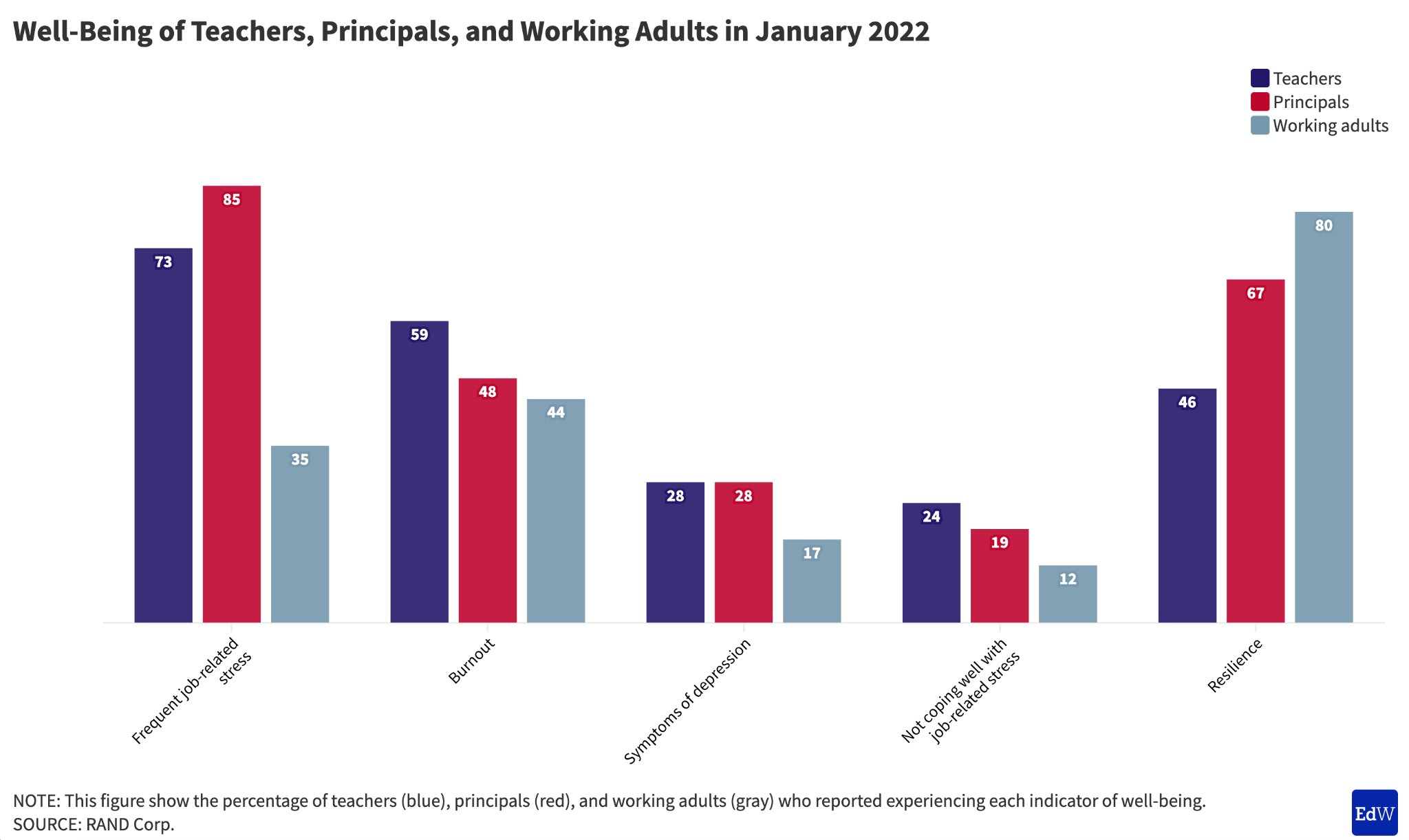
When principals were asked what drove that stress, three factors rose to the top:
Staffing teaching and nonteaching positions (56 percent)
Supporting teachers’ and staff’s mental health and well-being (44 percent)
Supporting students’ academic learning after lost instructional time (34 percent)
None of that is about curriculum or instruction. It’s about holding a building together with too few people and too little time.
That pressure shows up in who stays. Principal turnover peaked at 16 percent during the COVID pandemic. It has since fallen to about 8 percent, but that’s still well above the pre-pandemic rate of 3.3 percent. More principals are considering leaving their positions today than five years ago.
Research consistently shows that what helps most is what districts offer least: coaching and mentoring.
Coaching and mentoring are the most effective forms of principal development and also the least commonly offered. Fewer than 30 percent of districts provide a mentor to new principals. Only 8 percent do for veteran principals, the leaders who’ve been doing this long enough to know exactly what they need.
So, principals often have to find (and fund) their own personal development.
3 Steps To Practice Sustainable Leadership
A sustainable school leadership career depends on two things:
The internal side: What brings you joy, what makes you creative, and where you make your greatest impact.
The external side: Building a campus where you’re not doing all the hard jobs yourself.
Address only the internal side, and you’ll burn out trying to do it all with a full heart. Address only the external side, and you’ll build a well-run campus you don’t actually want to lead.
As a former teacher, principal, and educator, I’ve developed a three-step system to help you consider both. I’ve taught it in the Ruckus Maker community and in one-on-one leadership coaching for over a decade, and it’s helped thousands of principals find their way back to the job they signed up for—and turn it into a career they love and want to keep doing for years.
Let’s start with Step 1.
Step 1: Fire Yourself
Tiana was in sixth grade. At the end of the school year, she asked for help opening her locker.
As one of her teachers, I knew she could open her locker. She asked me to help her anyway, the way she’d asked me every day since August, back when I had shown the whole class how to do it. The old me would have said “yes” and meant it, then resented her for it. I worried the whole time about what was happening in my classroom while I stood in the hallway, wrestling with a lock she could work in her sleep.
So instead, I tried something different.
“Oh no, Tiana, what are you going to do?”
I handed the problem back to her and asked how she would fix it.
Tiana was a class clown, the kind of kid who turned every entrance into an event. The day I asked her that question, instead of opening her locker, we made a deal. She’d go practice the locker, and if she ended up late, I wouldn’t write her up. I said that was fine. She worked the lock herself, walked into class late, and for the first time all year, she didn’t make a grand entrance.
She gave me a thumbs up and sat down like it was nothing.
That’s a small story, but it taught me a big lesson in Sustainable Leadership. It’s the Robyn Jackson rule I come back to constantly: never work harder than your students. The same is true of your staff.
What are you doing right now that isn’t your job to do?
There’s a name for what happens when you don’t ask that question.
In The Courage to Be Disliked, Ichiro Kishimi and Fumitake Koga, drawing on psychologist Alfred Adler, explain how a lot of unhappiness comes from doing tasks that were never assigned to you in the first place. Most of those tasks come from expectations nobody set.
You cover a duty for a teacher that was his responsibility.
You handle a parent call that was meant for your dean.
You say, “You don’t have to cover everything, I’ve got you,” because the expectation to pick up any slack as a leader is strong.
Who puts this pressure on you? Half the time, the answer is nobody.
Discipline is a major area where you spend time doing jobs that aren’t yours. As a principal, you often become a detective. I know a principal who spent an entire week interviewing 60 kids about a group text. That’s a week he’ll never get back.
What helps hand this job over to others is a set of shared beliefs and values that staff and students buy into, so behavior gets addressed before it reaches your office. Seth Godin has a line for this: people like us do things like this. When a campus has that kind of culture, people hold each other accountable. Teachers feel equipped to handle the low-level stuff themselves instead of sending it up the chain.
I want to be honest with you: this won’t stop everything.
It won’t prevent every version of the day Bill had, the one where something big happens and thirty-two kids go home in a single afternoon. It won’t stop a kid from sending an inappropriate group text. Some days are just going to be that day. But it can keep discipline from becoming the water you swim in every single week, which is the difference between a hard day and a hard year.
Once you see what isn’t yours to carry, firing yourself becomes a two-part decision.
First, take inventory. Go back through your calendar from the last year and mark what brought you joy against what caused you problems. You’ll start to see a pattern in what’s honestly on your plate, not what you assume is on it.
Second, decide what you’re going to say no to. I’ve done this more times than I can count. A few years after starting the Ruckus Maker Mastermind, I fired myself as the only facilitator and hired a coaching team so I could have more time for 1:1 coaching. A few years after that, I fired myself from doing every coaching session solo and built Digital Danny. I keep firing myself from jobs I’ve outgrown, most recently the Better Leaders Better Schools podcast I hosted alone, which is why I’m bringing in co-hosts. Each time, firing myself from one thing created the space for the next thing that mattered.
This is harder than it sounds. Educators tend to have big hearts, and big hearts tend toward people-pleasing. Firing yourself doesn’t mean you get cold. It means you get honest about what gives you energy and explain that directly to your staff, without losing the warmth that makes you good at your job.
So how do you actually say no, out loud, to a real person?
Start with organizational power. Help the people above you (superintendents, district leaders, the school board) see everything else that’s already on your plate. When they ask you to take on more work, ask them directly: what gets edged out if I take this on? If they still expect you to do everything after that conversation, it might be time to look for a different job.
Next, build your own rules. I call these the Ruckus Maker Rules—three to five guardrails you can memorize, so a decision today makes a thousand decisions for you later. Nic Peterson, who wrote a short, sharp book called Bumpers, built his around refusal: “I refuse to start something I am not willing to do forever.” Mine leans on a philosophy Derek Sivers made famous: “If it’s not a hell yes, it’s a hell no.
A good rule reframes your no. Instead of “I don’t want to,” you say “this isn’t in alignment.”
That signals you’ve thought it through, instead of making an excuse to avoid the work.
Then put it in writing. Build a Principal User Manual that tells everyone you work with how you make your greatest contribution. Demetrius, a high school principal in California who created a User Manual, wrote that he measures his own success by how the community talks about his school at the grocery store. That shows how much he cares about the school and the community. Principals who’ve shared user manuals with staff and higher-ups often get thanked for their vulnerability. (If you want help drafting yours, Digital Danny is built for this kind of thinking work. Describe what you actually do well, and let it help you find the words.)
This first step takes time and thought. So, before you move to Step 2, sit with this question:
What will you no longer do?
What do you genuinely believe is no longer important enough for you to carry? And once you take that off your plate, how do you make your greatest contribution to your campus instead?
Once you have your answer, you’re ready to hire yourself.
Step 2: Hire Yourself
Dr. Chris Jones has been an educator in Massachusetts for twenty-four years, including sixteen as a building administrator.
He’s a teacher-centered principal who’s built his career on continuous improvement and the belief that success isn’t a destination but a process. He’s the past President of the Massachusetts State Administrators Association, and the Massachusetts School Counselors Association named him State Administrator of the Year in 2022.
None of that protected him from hitting a wall.
He’d written a book called SEEing To Lead and built a podcast. But when it became too much, he shut the podcast down. He wasn’t burned out in the way you’d expect. He was sick of it all, wondering what was next, unsure the job had much left to give him. His days as an administrator had become purely operational—logistics, scheduling, and keeping the lights on. He couldn’t access the creativity that got him into education in the first place.
When I started coaching him, we started where I always start. We separated what was actually in his control from what wasn’t. Then I asked him the question I’m about to ask you:
What brings you joy?
Chris was doing what the role required. But if you only keep the lights on and never do the thing you’re actually passionate about, why would you want the job?
During our coaching sessions, Chris shared that he loved to write. But as a published author, he felt pressure to write another successful book. I reminded him that a side project can stay a side project. Creativity doesn’t have to justify itself with scale.
Now, I’m happy to report he recently published a new book, The Leadership Riddle.
Once you fire yourself from the jobs that were never yours, you have to hire yourself for the ones that are.
Ask yourself why you became a teacher or a principal in the first place.
What got you into education? Are you still doing that, or has it been pushed aside by the tyranny of the urgent, one fire after another, until there’s no room left for what Greg McKeown calls “the vital few”?
For me, hiring myself looked like bringing together a group of high schoolers to run the Chicago Marathon. Over three years, I trained more than a hundred students to run it, and together we raised $50,000 for clean water. The only reason I could do that is because I’d already fired myself from jobs I didn’t want to do anymore.
One of those students, Mahogany Lawson, is now a tenured teacher pursuing her master’s.

On the left: Mahogany as a sophomore running the Chicago marathon. On the right: Today, she’s a tenured elementary teacher working on her masters degree.
You don’t need a marathon team to hire yourself. It might be running a basketball open gym after school. It might be leading new-teacher onboarding because you remember what it’s like to walk in blind. It could be teaching guitar lessons or putting together an improv comedy club or hosting a live event on campus.
The size of the project isn’t the point. It’s doing something you’re excited about.
What have you always dreamt of doing on your campus but haven’t had the space for?
For many school counselors, the honest answer is heartbreaking. They got into the role to hold space for kids, to listen, to help them develop as people. Instead, most of their day is spent on test prep and career-readiness checklists. That’s what the job becomes when nobody hires themselves back into the jobs they want.
When Chris Jones fired himself from admin tasks, he hired himself into something bigger. He got rid of finals and midterms at his high school. He convinced his community they didn’t need them, and he was right.
Firing yourself is work you do alone, and so is most of hiring yourself. But some of what you hire yourself for will need other people. You can’t build a new intervention system, or reinvent how your counselors spend their day, without your staff.
That’s where Step 3 comes in.
Step 3: Celebrate Your People
I want to tell you about a time I handled a relationship badly, because celebrating your people starts with understanding what happens when you don’t.
I was a quasi-administrator at the time, an instructional coach and teacher doing admin work without admin pay, with a key to every room in the building. The English department chair, who was also the union head, had started missing school two or three days a week. Her room connected to the department’s book room, so when she wasn’t there, teachers couldn’t get the texts kids needed to read. So I started letting myself in, unlocking her room and the book room, to keep the department running.
When she found out what I was doing, she was furious.
She wanted to talk about it, so I agreed. I’d read Crucial Conversations twice, annotated it, and practiced how I’d navigate the conversation. We sat down together in her room instead of my office, because I wanted her to feel comfortable.
It went badly anyway.
I’d scripted the conversation in my head (but I never gave her a copy), so she kept going off it.
What I understand now, with hindsight, is that we weren’t having the same conversation. I wanted to talk about the book room. She thought I was invading her space, maybe even reporting back to the administration on her about union communications, never mind that I was a union member myself, paying dues, who’d walked the picket line with her that same year.
There’s a term for this in Thanks for the Feedback, by Douglas Stone and Sheila Heen. They call it switch tracking—when two people talk about different things at the same time, and neither realizes it.
We got more frustrated with each other by the minute. She told me to give the key back to administration. I told her I’d give it back over my dead body. Then, I left the room.
I’m not proud of that story, but I tell it on purpose because it’s not a moment anyone should celebrate. I wasn’t living out any value worth naming. That’s the point: celebration only means something when it’s specific, and it only works when you understand what someone is dealing with, not what you assume they’re dealing with.
John Amaechi writes in The Promises of Giants that people make choices, and choices make culture. Earl Nightingale put it even more simply: we become what we think about. If your campus spends its energy dwelling on what’s going wrong, that’s the culture you’ll get.
Celebration is how you point people’s attention somewhere specific, on purpose.
Many schools try to celebrate people, and most of it doesn’t land.
Staff Member of the Month. A generic “thanks, everyone” at a staff meeting. Mission and values written once at a retreat, posted on a hallway wall, and never mentioned again. None of that means anything because it’s generic. Nobody practices it daily.
Part of celebrating your staff is knowing what’s on their plates and where they need help.
You can’t do that hiding inside your office.
Once you’re not doing every job yourself, per Step 1, you need a way to notice what everyone else is doing well. Dan Sullivan calls this “Who, not how.” Instead of asking how you’ll get something done, you ask who’s already doing it.
Here’s the tool I use, called the Positive Spotlight:
What are you celebrating?
Why does it matter?
How does it connect to your school’s or community’s values?
What’s the next step to amplify it or spread it beyond this one person?
How do you tell the story campus-wide and community-wide?
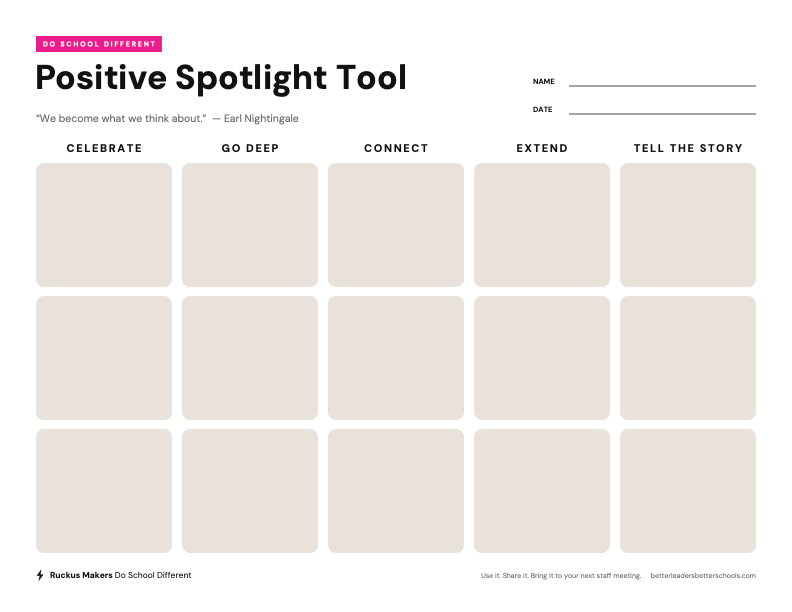
For example, when I want to celebrate someone on my team, I don’t just say “great job.” I say something like, “I really appreciate the research and the sharp questions you bring to every coaching call, and here’s exactly how that shows up in one of our values, and here’s why that value matters to us.” That’s the difference between a compliment and a spotlight.
The fourth step, amplify, is the trickiest one.
Sometimes it means asking the person being celebrated: is there anything you wish you’d had more support with, even in your best moment? Sometimes it means asking whether what worked for one teacher could work for others too. Either way, don’t stop at “good job.” Ask what’s next.
None of this works if you try to do it all at once.
I’m a big believer in what Jim Collins calls firing bullets before cannonballs. Pilot an idea before you scale it to the whole school. Map your staff and figure out who’d be all in on a new idea—maybe even the person who brought it to you. Collect real data. Build a case. Then, show results before you ask everyone else to follow.
Seth Godin calls this enrollment—people choosing to do the work themselves, instead of being assigned to it.
As you fire yourself from more jobs, remember: what you hate, someone else loves.
Maybe you dread giving the graduation speech, but your assistant principal is a natural storyteller who’d light up at the chance. Firing yourself from a job you resent isn’t a loss. It’s an opening for someone who’s been waiting for it.
I haven’t fully proven this yet, so take the following as an idea, not a guarantee.
I think celebration does two things at once. It makes people want to do more, because feeling seen is motivating in itself. And when you’re transparent about what you’ve fired yourself from, through your user manual and the values you keep practicing out loud, people start to self-select into the work. They hear that a job is open, and some of them raise their hand.
Close the loop, and you’re practicing the third part of Sustainable Leadership.
You fired yourself from what wasn’t yours. You hired yourself into what brings you joy. Now you have the time and energy to build a campus where the people around you want to pick up what you put down. And you can celebrate them when they do it well.
Let’s talk about how you keep all three of these practices going, every single day.
Sustainable Leadership Practices
The three-step system gets you unstuck, but these practices keep you from getting stuck again.
Practice gratitude, not toxic positivity.
Every morning, I write down three things I’m grateful for.
It’s a small habit, and it works for me. I’ve traveled enough of the world to know that most people on the planet would trade places with me in an instant, even with whatever’s going wrong in my own life. Having a house, clean water, and enough to eat isn’t nothing.
That doesn’t mean brushing off real problems. It means staying grounded enough that the hard parts of the job don’t become the whole story.
(One caveat: If you’re genuinely struggling, gratitude isn’t a substitute for professional support. Three good things in a journal won’t fix what needs a therapist.)
Slow down, and make time to do nothing.
Most people in this job are constantly on, always doing and always moving to the next thing with no real break built in.
That’s why I took up improv a few years ago, even though it has nothing to do with school leadership. Yes, it’s made me a better public speaker. But that’s not why I do it. I do it because it’s fun, and because having something in your life that exists purely for its own sake, with no professional payoff attached, is part of what makes this work sustainable.
Principals in our community have found their own versions: guitar lessons, CrossFit, meditation, storytelling at The Moth.
Find your version of improv—something you do simply for fun’s sake.
Practice self-care, not district-care.
We’ve spent this whole book naming real, systemic pressure like understaffed buildings, thin support, and a job that asks more of you every year. That pressure is real, and it isn’t your fault. But naming it isn’t the same as being able to fix it, and while you’re waiting on the system to change, you’re the one living inside it every day.
Ask yourself: What are you doing, or what could you change, to feel better?
It’s easy to point at the district, the context, or the reality of the job, and stop there. I’d rather you take responsibility for your own well-being. Both things are true at once: the system needs to get better, and so do the habits you build around it.
These three practices don’t replace the three-step system, but they help make it stick.
A Career Worth Building
Two years ago, I led a summit on sustainable school leadership in Nashville, and I left people with the same question I want to leave you with.
If Ruckus Makers don’t stay in the game, who’s left to do it?
The Play-It-Safe Principals. The ones managing from someone else’s rulebook, waiting for the system to fix itself before they do anything different. If they’re the only ones left standing, the kids lose too. That’s what happens when the people doing the most demanding, most important work in education burn out and leave, and nobody’s built anything sustainable enough to keep them.
To show how that can happen, and how to turn it around, I want to end with Dan Watt’s story.
Dan is one of my podcast co-hosts, mastermind coach, newsletter writer, and he’s still a working principal today, up in British Columbia.
A few years ago, Dan hit a point where he knew, in his own words, “this is not good.”
Dan’s been in recovery for decades. He’s open about his struggle with alcoholism and how he’s been sober a long time. That experience taught him something most people don’t learn until it’s too late: how to recognize the moment before things get bad, and what to do about it. So when he felt himself heading somewhere he recognized, he didn’t wait it out.
He took a medical leave from his position as a principal, and it ended up lasting three months.
When he came back, he didn’t come back to the same job in the same way. He started at a new school. That’s highly unusual, but his superintendent could see that a move out of his old school was called for, and helped him land on his feet.
Eighteen months later, Dan took a different kind of break: a self-funded sabbatical he’d planned three years in advance.
It lasted a full year, fourteen months with the summers rolled in. He’d planned an ambitious trip to mark the moment, but at the last minute, COVID canceled it. He took the year anyway, just differently than he’d planned. He gardened. He worked out. He read and wrote more than he had in years.
Sabbaticals are far less common for school leaders in the U.S. than in some other places.
But Dan knew himself well enough to recognize when he needed to step away, and he did.
He’s still a principal, but now he’s also coaching other school leaders, writing, and podcasting alongside me. He went back in with a community and support system built to last, not just the willpower to push through alone.
Dan fired himself from the version of the job that no longer worked. He hired himself into coaching, writing, and podcasting, work he wanted to do. And he built a community around himself so he wasn’t carrying it all by himself.
You probably can’t take a year off, and that’s okay. Most people can’t.
But the instinct underneath Dan’s story scales down. Maybe it’s a weekend with no laptop and no email. Maybe it’s one week of actual vacation, fully protected, instead of half-taken with your phone still in your pocket. The length of the pause isn’t the point. What matters is whether you’re willing to take one on your own terms, before the job forces one on you.
You’ve read this far because some part of you knows the current pace of your career isn’t sustainable.
Now, you have three steps:
Fire yourself from what was never yours.
Hire yourself into the work that actually brings you joy.
Celebrate the people who pick up what you put down.
You also have three practices to keep you honest while you do it.
Yes, students will still need you, and staffing will still fall short some mornings. But you get to decide whether you do this work in a way that lets you stay in it, and stay whole, for as long as you want to be here.
Go build a campus, and a career, worth staying for.
Keep Making a Ruckus,
Danny
Reading about Sustainable Leadership is helpful, but acting on it is how you change your career.
The Ruckus Maker Mastermind is a weekly Selfmentorship practice for principals.
Once a week, your cohort meets on Zoom for an hour. One member brings the problem keeping them up at night, and the room works on it together. You’ll work on firing yourself, hiring yourself, and celebrating your people alongside principals from across the country.
Danny, the point that principal stress comes from holding a building together with too few people rather than from curriculum is an important one, and the question of what you will no longer carry is a useful test of how a role is designed. In my experience, sustainable leadership depends on the school sharing responsibility through clear structures and distributed leadership, so that no one person's energy is what keeps things running. How might trusts and governors design that capacity in, rather than leaving each principal to find it alone?
The line about coaching and mentoring being what districts offer least stuck with me. Leaders need someone in their corner too, not just more on their plate.