

👋 Welcome to Ruckus Makers the home of Selfmentorship. We write for leaders who are done waiting for the system to develop them and have taken radical control of their growth. If that’s you, then subscribe below and you’ll know the moment a new mini-book drops ⚡️
Rethink Interviews to Make the Best Hire
I could tell as soon as a candidate walked in the door at our school in Texas whether they would be hired or not. It wasn’t because I have telepathic abilities and could read their minds to know if they have the right experience or skills. It wasn’t because I had secret, early access to their resume or cover letter during the interview process either.
No, unfortunately, it was way more basic than that.
It was all about how they dressed.
I knew that someone could get hired at my school if they were an alumni of the school, had attended Texas A&M, and wore Vineyard Vines. You had to look the part—both on paper and in person. And other than that, it didn’t matter how much someone could or couldn’t contribute to the health of our learning environment. I remember watching candidates with interesting ideas and novel perspectives and incredible experience interview for open positions, knowing that because they didn’t look the part, they would never get the job. It was incredibly frustrating for me.

At most districts, the biases and prejudices surrounding the interview process are not so extreme or obvious—but they still exist.
Most of us pride ourselves on being able to read others, on being good judges of character. It’s hard not to trust the feeling we get in the pit of our stomach that someone will or will not be a good “culture fit” for our team.
The problem is that our intuition is not a reliable indicator of someone’s efficacy in the classroom or their future success in our district. Our intuition usually tells us to prefer someone who is just like us, whether or not we consciously realize it or not. This is how implicit bias works.
At my previous school district, they suffered from the halo effect—a specific type of implicit bias in which the hiring team allows one overt, potentially superficial detail about a candidate (like the right “look,” right school background, etc.) cast a positive glow over everything about them and blind them to possible red flags.
Other types of implicit biases often show up during the interview processes at schools: gender bias, racial bias, ageism, affinity bias (wanting to work with someone who resembles ourselves culturally), and first impressions bias (making snap assumptions about a candidate).
They all have the same effects:
Less racial, ideological, and cultural diversity in our schools
Hiring the wrong people who aren’t fully committed to the vision and mission
Missing the opportunity to hire someone who would be a truly great fit
Superintendent Lupita Hightower has felt the effects of implicit—and even explicit—biases throughout her career. Often, multiple biases were at work at once.
“Because I'm a woman with an accent, I had a lot of bad experiences with interviewing,” she shared, “from my principal telling me that they don't need people like me in her district to a professor saying, ‘You'll never be able to step into a classroom because when you speak, you speak with an accent.’”
As a result of these comments, Lupita was nervous about interviewing for teaching and administrative positions. She felt like she had to over prepare and applied to jobs she didn’t want just to get more practice interviewing and rehearsing her answers to questions.
Now, as a superintendent for the past thirteen years—and having been named the 2019 and 2023 Arizona State Superintendent of the Year—Lupita has instituted new hiring practices to reduce implicit biases throughout her district’s hiring process. She is determined that no candidates who apply to their district will have to face the prejudices she experienced.
Solving for implicit biases in education—and even in our hiring practices—is a complex issue that cannot be resolved overnight. Schools should be engaged in rigorous equity work with qualified consultants to help them design more equitable processes, but over the years of coaching hundreds of school leaders, I’ve found the following strategies to be good places to start.
Blind Screening
If you’ve ever seen NBC’s The Voice, then you have an idea of how blind screening works. The concept was popularized by a 2000 study in which symphony orchestras held blind auditions to test whether they might avoid gender bias in their hiring and increase the number of women hired to orchestras. It worked; the study found that having candidates stand behind a curtain as they played their instrument increased the chances of female instrumentalists being hired.
Since that study, blind screenings have become a popular strategy for trying to eliminate implicit biases. Usually, identifying information or information that could convey social class or other potential group identities—like names, hobbies, or college graduation years—are removed from resumes, applications, and cover letters (Fath, 2023). Several studies have shown that doing so, in most cases, does result in a more diverse pool of applicants being asked to interview.

Lupita’s team uses blind screenings in another way when hiring for instructional coaches, directors, and other administrative positions. They have created a rubric for each job position to ensure that candidates have the required experience. If a candidate meets the requirements of the rubric, then they come in for an “in-basket activity,” a written problem-solving exercise designed by the team to assess the skills required for that position. But here’s the catch: No one on the team knows whose assessments are whose. Candidates are given a number, then the in-basket activities are proctored by their IT director—the only person who knows which candidate has which number.
When the in-basket activities are complete, the hiring team grades them according to another rubric and decides which numbers they want to interview. Then they have a reveal, where the IT director shares the names assigned to each number. The candidates who are chosen to interview get a yellow ticket inviting them to return—just like American Idol.
Lupita says this process has worked incredibly well in helping them hire a diverse staff for their central office and administrative positions.
“We have a lot of women leaders—like almost our entire district, except for IT and Operations,” she says. “And they’re diverse. They’re white, Black, Latina. You don’t see that in a lot of school districts. But these women came up on top.”
Once, a board member raised a concern that they were hiring too many women.
“I was like, ‘They were the ones who rose to the top!’ They were the best ones,” she responded.
Although blind screenings are a great place to start for most schools and several studies support their efficacy, blind screenings alone are not enough.
Self-Assessment
Ask candidates to assess themselves using the Staff Success Scorecard you created in Chapter 1 and bring in their assessment to discuss during your individual interview with them. Having something to look at together gives you a good foundation for asking better questions that give you a more accurate picture of how this person would operate within the culture you’ve created. It also gives you an opportunity to observe how they react to the Scorecard itself. Are they on board? Do they understand all of the categories? Or do they disregard it as unimportant, a minor formality?
During the next phase of group interviews, you’ll want to keep their Staff Success Scorecard handy so that you can compare their responses to what you and your interview team observe in person as well.
The great thing about the Scorecard is that candidates walk away from the experience with a personalized plan for their own learning and growth as teachers. This is an incredible gift to them, whether or not you end up hiring them. We’ll talk more about how to use the Scorecard to plan onboarding and PD in Chapter 3.
Group Interviews
Group interviews at schools involve problem-solving scenarios and collaborative activities where candidates have to work together quickly and productively. The Society for Human Resources Management says that group interviews, “allow an interviewer to observe the candidates’ ‘soft skills’ such as teamwork, problem solving and interpersonal communication” (YEAR).
Lupita’s district also uses group interviews during their hiring process, and the experience, she says, is “very telling.”
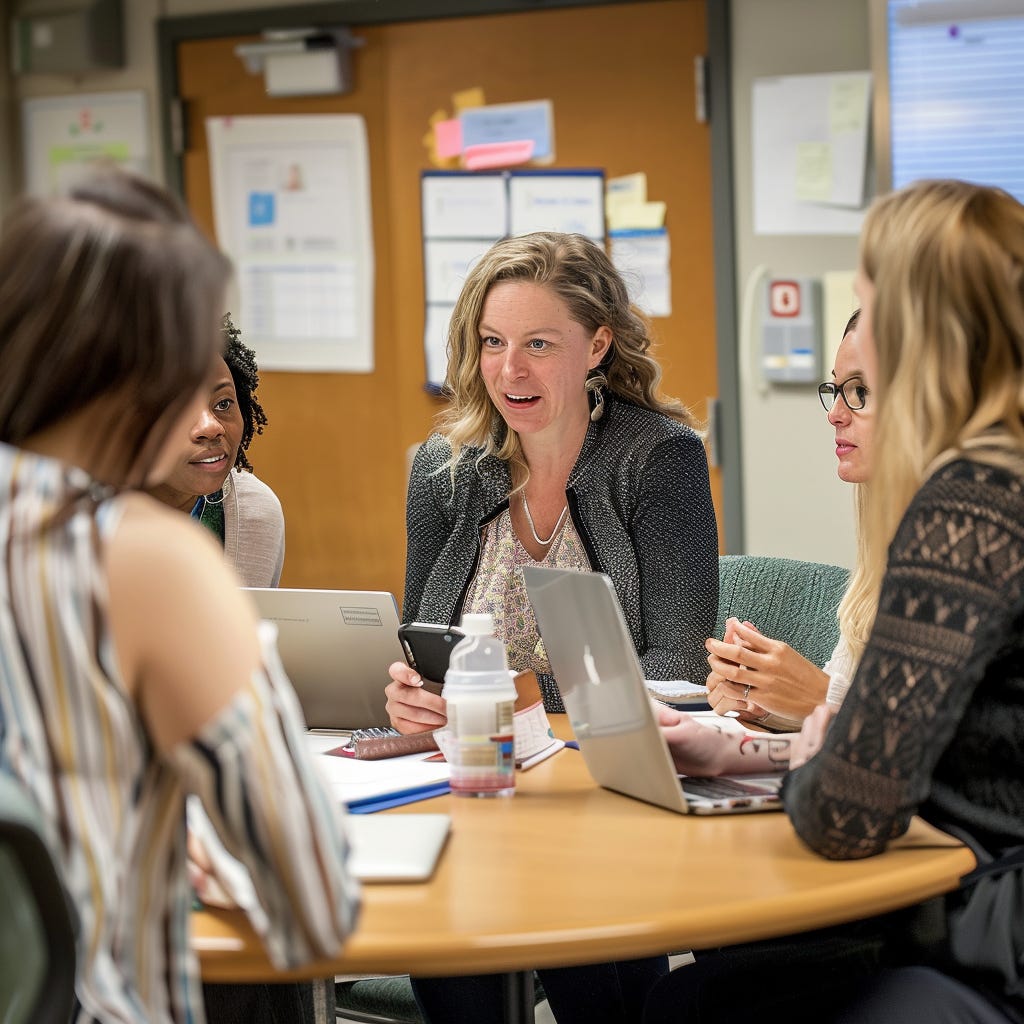
She shared a group coaching exercise that candidates were asked to collaborate in. “Some people were more negative reinforcers—more direct—that we knew wouldn’t fit within our culture. Or it would be a lot of work to try to teach them cognitive coaching. And then others were quickly able to build relationships and focus on the objective and offer support.” Using these kinds of group interviews is like a shortcut to seeing candidates in action and deciding early on whether they have the necessary skills.
In the best cases, group interviews are fun and provide a good learning experience for the candidates, offering the school’s leadership team a chance to mentor aspiring teachers—even if they don’t end up hiring them. Besides, the best teaching and leading is collaborative rather than siloed, so conducting group interviews is more authentic to what their lives as teachers in the school will (hopefully!) look like. It’s also a good strategy if you need to hire for multiple positions at the same time.
Stephanie, an educator at an international school in Singapore, described her first group interview experience like this:
“It was run with clear learning intentions and success criteria, there were individual tasks, group tasks, pair tasks. We were planning lessons, talking pedagogy and learning about leadership. If nothing else comes from the interview, I got a free afternoon of professional development run by some amazing school leaders with some brilliant student teachers. That’s the first time I’ve ever come out of a job interview and immediately wished I could go back for another session.” (2011)
If you have an interview process that has candidates singing your praises like this, it’s more likely that you’ll end up with the right candidates to choose from.
Group interviews are also a great way to put the Staff Success Scorecard you created in Chapter 1 to good use by designing projects and scenarios that reveal candidates’ skills in each of the categories you chose. Be sure to give each member of the interview team a copy of the Scorecard so they can write down their observations and make note of where each candidate is excelling or struggling as the interview progresses.
Back at my previous district, I had suggested trying out group interviews to see how potential candidates work together. The suggestion was declined at the time, but I was happy to hear some time later that they had adopted the group interview process after all.
Quick leadership lesson: Sometimes leadership is about planting seeds and challenging the status quo, knowing full well those seeds may come to fruition after your time!
Other Ways to Rethink Interviews
The best way to switch up the interview process is to have it start in the main office as soon as a candidate walks in—before they even know it’s started. The men and women who run the main office at a school or central office are the heart of the building. They know everything that’s going on and they know all of the people there. Give them a copy of the Staff Success Scorecard and ask them to watch out for any indicators of where a candidate might rank on any of the values or categories. It’s likely that they’ll notice things you and your interview team won’t when the candidate knows that they’re being evaluated and assessed.
Another fun idea might be to manufacture some kind of crisis in the lobby while they’re waiting for the interview to start, like a problem with the copier. If the executive assistant asks for help, how will a candidate respond? Will they defer and say, “No, I’ve got an interview scheduled,” or will they jump up and offer to help even before being asked? Or are they so engrossed in their phones that they don’t even realize what’s going on?
After the formal interview process is over, make sure that you ask the main office staff for their impressions and their ratings on the Scorecard.
It’s also a good idea to include students on your interviewing team. Again, share the Staff Success Scorecard with them and ask them to help evaluate the candidates. Students will pick up on things that you miss and ask questions you never thought of. Plus, including students in the group interview process can give you a chance to see how candidates interact with kids.
Lupita says that taking candidates to schools to see them interact with kids and with other staff has often helped her make final decisions about who to hire.
Trust Your Instincts—After the Facts
In his bestselling book Thinking, Fast and Slow, psychologist Daniel Kahneman writes about his experience as a young recent graduate designing the interview process for incoming soldiers for the Israeli Defense Forces (IDF). Kahneman had no idea what he was doing at the time, and so he relied on a book by an American psychologist, Paul Meehl, to guide him. Meehl argued against interviewers trusting their guts, and instead encouraged them to prioritize more objective evaluations against highly specific metrics. Kahneman tried out these recommendations, creating a list of six characteristics that he thought were relevant to soldiers’ performance in the IDF, creating questions for each of the characteristics, and then instructing interviewers to ask exactly those questions and rate the candidates according to their answers.
The interviewers hated the process, though—complaining that Kahneman was taking away all of their own “expertise” (which was kind of the point). So, to make them happy, he added one more question at the end of the interview.
“‘Carry out the interview exactly as instructed,’ I told them, ‘and when you are done, have your wish: close your eyes, try to imagine the recruit as a soldier, and assign him a score on a scale of 1 to 5.’”
Kahneman was surprised to find that the interviewers’ instinctual ratings were just as accurate as the more objective ratings they had been asked to give.
His conclusion?
“Intuition adds value… but only after a disciplined collection of objective information and disciplined scoring of separate traits.”
To put all of this together, use your Staff Success Scorecard to help you and your interviewing team (including students, front office staff, and others!) decide who has the most potential on paper. Then close your eyes and imagine them teaching in your school. What do you see?
At the end of the day, hire good people. You can teach a good person skills, but it’s a lot harder to teach integrity, work ethic, and character. For those attributes, trust your instincts.
Reflection Questions
Be Innovative: How might you change up your interview process to avoid blind spots and biases?
Be Intentional: How much have you been relying on your instincts versus the hard facts when it comes to making decisions about staff?
Be Proactive: How can your interview process not only help you make a good decision for your team—but also provide value for the teacher candidates?
If this landed for you, here are a few ways to keep going.
Meet Digital Danny. Digital Danny is your Selfmentorship guide. Always available. Never flatters. Evolves with you. Start your 7-day trial here.
Join the Ruckus Maker Mastermind. If you’re serious about Selfmentorship and want a community of Ruckus Makers doing the work alongside you, this is where they are. Learn more and apply here.
