

👋 Welcome to Ruckus Makers the home of Selfmentorship. We write for leaders who are done waiting for the system to develop them and have taken radical control of their growth. If that’s you, then subscribe below and you’ll know the moment a new mini-book drops ⚡️
Grad school taught you how to run a school. It did not teach you how to create a campus experience worth showing up for.
That’s a big problem …
(if you’re a Ruckus Maker)
Because your #1 job is to create a campus experience worth showing up for.
Simply learning to be a better, more efficient manager of campus resources will not inspire your community. Bell schedules, graduation, teacher evaluation are all important. They are table stakes of running a school.
But to create something legendary?
That requires a Do School Different approach.
The kind that we write about here.
In our view, there are two types of school leaders:
Play-It-Safe-Principals read what the system assigns them without question. They protect the way it’s always been done.
Ruckus Makers read far and wide outside of education. Not because they think education is broken, but they prioritize learning from a wide variety of disciplines.
An echo chamber exists in every school system in the world. There is shared language, operating procedures, and other efficiencies that exist to make life easier in any system.
And if you have ever asked, “There must be a better way …” this post is for you.
I made a list of 10 books that will support your Do School Different vision. Books I love. Books that we’ve read in The Ruckus Maker Mastermind since 2016.
None are a book from the K12 industry. You’ve already read those.
This list are my favorites from the last 10+ years supporting bold school leaders. I share the top ten list in the video below. Then I ask Digital Danny, my AI clone, what he would suggest. I’m glad I did because he offered a few gems that I didn’t include originally.
Here’s the list, with one big idea from each text.
1. Stillness is the Key by Ryan Holiday
Sports psychologist Dr. Michael Gervais says elite performers never talk about effort. Working hard is table stakes.
According to Gervais, what elite performers discuss on the world stage is recovery because when you’re already working hard, recovery is what separates the best from the rest.
There’s a reason every framework I teach starts with taking care of the individual leader first (even before family). You can’t our from an empty cup.
2. The Inner Game of Tennis by Tim Gallwey
Yes, this book is about sports performance. So how does it relate to school leadership.
Gallwey names the two selves inside every Ruckus Maker.
Self One is the critic. The voice that says why’d you say that, you’re not ready, this will never work.
Self Two is the doer. The one who has to walk the halls and build a campus experience worth showing up for.
When Self One talks too much, Self Two plays small. And a principal playing small puts a ceiling on what results a campus can create.
3. Emotional Intelligence 2.0 by Travis Bradberry & Jean Greaves
Ruckus Makers love this book because it is super practical.
You take an assessment and score yourself across four domains of emotional intelligence: self-awareness, self-management, social awareness, relationship management.
Then, you choose your lowest area and get to work. The authors provide 15 activities per area of emotional intelligence. Do the work and your results will grow.
4. The Art of Gathering by Priya Parker
As school leaders, we bring people together all the time.
The problem is that we take these gatherings for granted and as a result, they are mediocre.
Staff meetings. Open house. Graduation.
Boring. Boring. Boring.

And here’s the thing …
With just a little bit of intentional effort, you can create legendary experiences on your campus.
The kind of stuff people are excited about.
After reading this book, you’ll never think of Open House the same.
5. Tiny Habits by BJ Fogg
According to Fogg, behavior is a function of motivation, ability, and a prompt.
B = MAP
This is a revolutionary framework.
Most school leaders (mistakenly) believe that people when staff doesn’t follow through they either are unmotivated or simply don’t care.
The B = MAP model shows this is likely wrong.
I believe people care deeply about their work (and want to know they are doing a good job too).
What is usually missing is ability (they need training and development) or a prompt (a cue that says it’s time to do “X” behavior).
When you understand this model, people start to do what you want. It’s like a Jedi power 🔮
6. The Infinite Game by Simon Sinek
Finite games have winners and losers. Finite leaders think, “In order for me to win, you must lose.”
Infinite games are about abundance.
You don’t have to lose for me to win. And what if the game never ends?
Schools and school systems compete a lot in the finite game zone. Students would benefit for us to figure out how to play a more generous, and infinite game.
7. A Beautiful Constraint by Adam Morgan & Mark Barden
The head of Random House bet Dr. Seuss $50 he couldn’t write a book using only 50 words.
Seuss accepted the bet and created Green Eggs and Ham—his best-selling book ever.
Constraints are beautiful.
The obstacles become the path to greatness once you use them as the starting (and not the end) point.
“We can’t” and “That’ll-never-work” thinking has never produced anything remarkable.
Only “What would need to be true” type of thinking gets the job done.
8. Thinking in Bets by Annie Duke
Everyone knows a time they made a very poor decision, but it resulted in a good outcome …
(I’m looking at your college years)

We also know there are times when we have a solid decision making process, and yet, the outcome stinks.
As Frank Sinatra says, “That’s life.”
The problem I see many school leaders make is that they over-value outcomes and under-value process.
And the problem with that kind of thinking is that it elevates what is NOT in your control (the outcomes) over what is in your control (the process).
Annie Duke challenges us to turn that around.
This book is a masterclass on decision making.
9. Radical Candor by Kim Scott
I fear that most educators practice what Scott calls Ruinous Empathy. That’s when you care a lot, but you are not direct. You tend to dance around issues.
But to be a Ruckus Maker you need to care and be direct. This is what Scott calls Radical Candor. It’s also the only kind of feedback that works and helps people be their best.
Gene Park is a sitting principal in NJ and current mastermind coach. He read this book with his staff and trained them on the four quadrants of Scott’s framework:
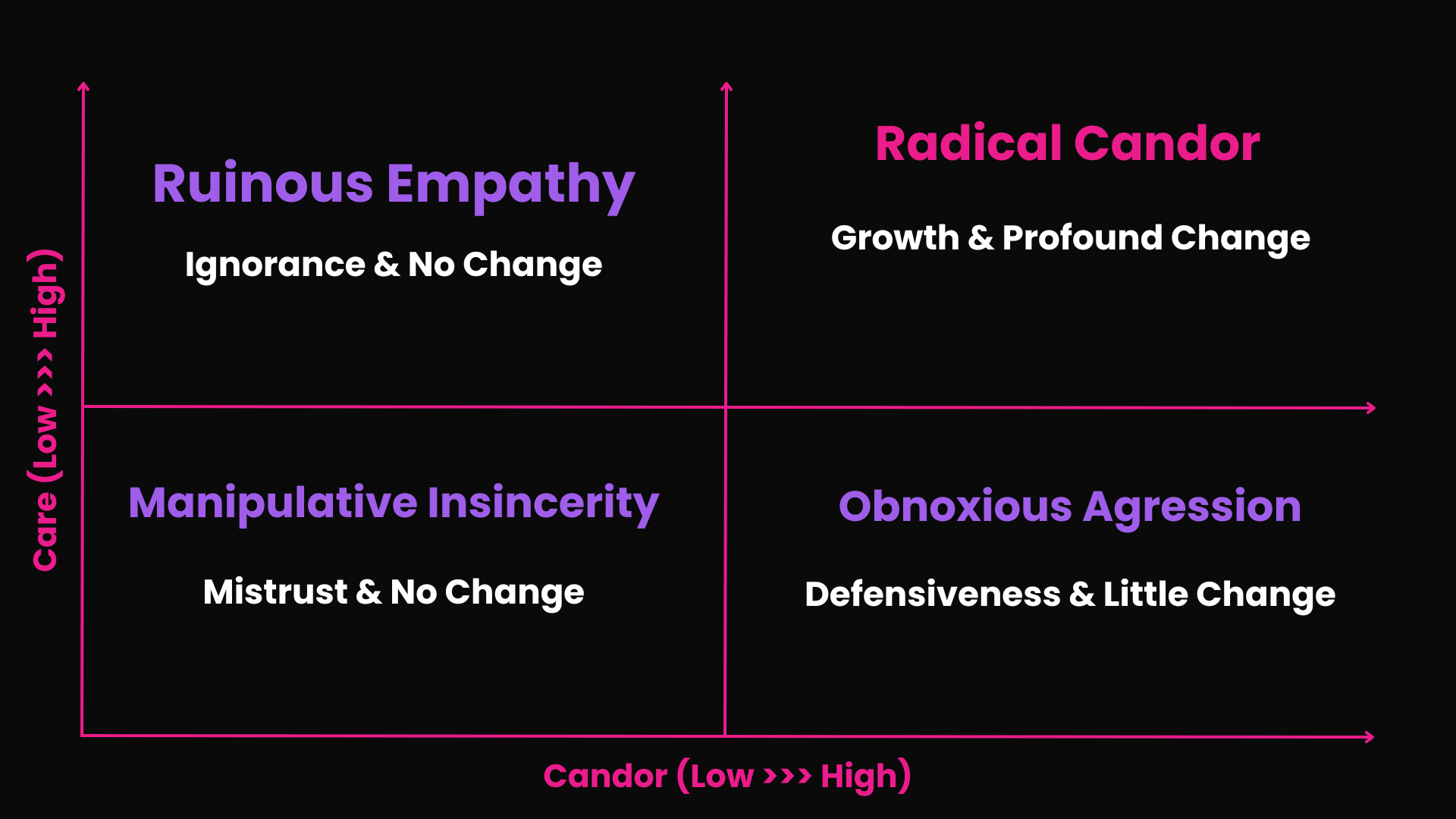
After conversations with staff, he brings up this grid and asks in the moment where his communication landed. Imagine that kind of feedback loop done every day with staff.
That’s what makes Gene a King of Culture.
10. Man’s Search for Meaning by Viktor Frankl
This book is my all time favorite for Ruckus Makers and sits in my personal book Hall of Fame.
My copy is earmarked and the “marginalia” is written everywhere.
Frankl survived Auschwitz, and his core idea is radical ownership:
Life is going to ask you what it means. How anyone else answers doesn’t matter. The only answer that counts is yours, because you’re the one being asked.
School leadership is tough. Frankl’s lived experience was objectively tougher. Learn how to thrive in adversity because expecting anything else is naive.
If this landed for you, here are a few ways to keep going.
Try Digital Danny for 90-days or for the entire year. Digital Danny is my AI clone trained on 10+ years coaching school leaders. He’s always there. Never forgets. And evolves with you.
Apply to the matsermind. This is our weekly, peer mentorship experience. Bring your thorniest issues to a group of colleagues that gets it. If you’ve ever shared your Do School Different vision in your district and other principals look at you like you’re crazy … this is your group.
Listen to the Better Leaders Better Schools podcast. You’ll find over 10 years of conversations with the most interesting people doing the most interesting work in school leadership. Start anywhere.
Thinking outside the box is hard in practice because we exist in a box. However, we must strive for this, to innovate and laugh together as this can motivate and engage … then everyone can reach their potential without judgement in a perfect world. I recently retired from nearly two decades as a principal … I loved every minute of the chaos.
Once again you have nailed it. These books are great for anyone who wants to lead differently. Whether you are a principal or a college student these books have a lot to offer. And after you have read all of them once you can read them again you will get more out of them.